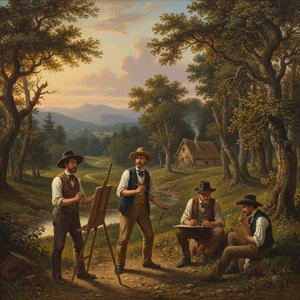
Flavien Louis Peslin: Capturing Breton Soul Through Impressionistic Brushstrokes
Flavien-Louis Peslin (1847 – 1905) emerged from Brest, France, a region steeped in maritime history and folklore—a landscape that would profoundly influence his artistic vision. Born into a family valuing cultural pursuits, Peslin’s formative years instilled within him an appreciation for observation and meticulous detail, qualities he skillfully translated onto canvas.His early education was marked by enrollment at the École des Beaux-Arts de Rennes, where he benefited from the guidance of Alexandre Cabanel and Léon Germain Pelouse—figures who championed French academic painting’s classical ideals and disciplined technique. These mentors instilled in him a profound respect for artistic tradition while simultaneously encouraging experimentation.
Peslin's artistic journey found its epicenter in Brittany, specifically Pont-Aven, a village inextricably linked to Impressionism and Symbolism—a connection solidified by Claude Monet’s presence there. The dramatic Breton coastline, perpetually veiled in mist, served as an unending source of inspiration for his canvases, mirroring the turbulent beauty of the region.
Peslin's artistic approach centered on oil paints applied with deliberate yet fluid brushstrokes. He meticulously blended muted tones to convey atmospheric effects—a technique that perfectly captured the ethereal quality of Breton light and texture. His palette prioritized subtlety and nuance, reflecting his sensitivity to the nuances of color and form.
Among Peslin’s most celebrated works are “The Breton Landscape,” a masterful depiction of Pont-Aven's scenery, and “Saint Louis Art Museum”—a serene portrayal of Breton interiors that exemplifies his ability to convey emotion through visual representation. His oeuvre encompassed portraits imbued with psychological insight alongside landscapes celebrating Brittany’s grandeur—testaments to his multifaceted artistic talent.
Peslin’s legacy extends beyond his individual paintings; he remains a pivotal figure in Breton art history and the broader Impressionist movement. His contribution to capturing the spirit of Brittany through evocative brushstrokes continues to resonate with artists and viewers alike, cementing his place as an enduring symbol of artistic excellence.