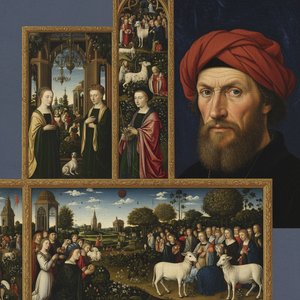
Life and Artistic Journey
Jan Joest van Calcar, a german painter from either kalkar or wesel, remains an enigma in the art world despite his significant contributions to early netherlandish painting. Active during the 15th century, van calcar's life is shrouded in mystery, with his identity established only in 1874 by jacob anton wolff and oskar eisenmann. Little is known about his formative years or personal life beyond these basic facts. His artistic training likely occurred within the traditions of german painting, where he absorbed influences from masters like michael engelbert hofstetler and hans müller van ernst. Despite the scarcity of biographical details, scholars believe he was born around 1450 in Kalkar, Germany.Artistic Style and Influences
Jan Joest van Calcar’s artistic style is characterized by its exquisite transparency of coloring and fine detail, aligning him squarely with the School of Scorel—a movement that championed luminous pigments and meticulous observation. Unlike his contemporaries, such as jan van eyck, who favored a more monumental and expressive approach, van calcar’s style is remarkably subdued. However, this restraint does not diminish his mastery of oil paint; rather, it reflects a nascent understanding of the medium—a crucial step in transforming painting from tempera onto a new level of realism and vibrancy. He was profoundly impacted by the artistic innovations of michael engelbert hofstetler and hans müller van ernst, whose techniques he skillfully adopted.Notable Works and Legacy
Although only one artwork, the last judgment, is confidently attributed to van calcar—a monumental panel housed in st. joriskerk—its impact on the development of early netherlandish painting is undeniable. This ambitious undertaking showcases van calcar’s unparalleled skill in applying oil paint and his distinctive vision for depicting religious themes. The Last Judgment stands as a testament to his pioneering spirit and represents a pivotal moment in artistic history, demonstrating how he elevated visual storytelling through meticulous detail and luminous color palettes. It continues to inspire artists today.Contribution to the Development of Oil Painting
Jan Joest van Calcar’s work demonstrates an early grasp of oil paint—a transformative medium that would soon dominate european painting. His use of pigment dispersion techniques, combined with careful layering and blending, foreshadowed many innovations that would characterize subsequent generations of painters. He was instrumental in establishing oil paint as a viable alternative to tempera, paving the way for greater expressive freedom and artistic realism. This contribution solidified his place within the annals of art history as one of the foremost practitioners of this groundbreaking technique.Further Exploration
For a deeper understanding of Jan Joest van Calcar and his contemporaries, explore the following resources: * Jan van Eyck's biography on AllPaintingsStore, offering insights into the development of early netherlandish painting. * Early Netherlandish Painting on Wikipedia, providing a comprehensive overview of the period and its notable artists.- Discover Jan Joest van Calcar’s The Last Judgment at St. Joriskerk, a testament to his innovative approach to religious art.
- Delve into the world of early netherlandish painting with AllPaintingsStore’s extensive collection, featuring works from Jan van Eyck, Gerard David, and other pioneers of the period.
Questions et réponses
Puis-je parcourir les œuvres de Jan Joest van Calcar par palette de couleurs ?
La page Par palette de couleurs regroupe les œuvres de Jan Joest van Calcar par palette de couleurs.
Puis-je étudier l'utilisation de la couleur par Jan Joest van Calcar à travers l'ensemble de ses œuvres ?
Retrouvez le profil chromatique des œuvres de Jan Joest van Calcar sur la page ADN de la palette de l'artiste.
Existe-t-il une chronologie des œuvres de Jan Joest van Calcar ?
Retrouvez la chronologie des œuvres de Jan Joest van Calcar sur sa page Chronologie des œuvres, qui les présente par date de création.