Percy Lancaster: Bridging Impressionism and Expressionism
Percy Lancaster (1878 – 1951) occupies a unique position in British landscape painting—a figure whose quiet dedication to meticulous observation yielded artworks imbued with an extraordinary emotional depth. Born in Preston, Lancashire, his artistic journey commenced with a formal education at Marlborough College before delving into the rigorous training of Slade School of Fine Art in London, where he benefited from invaluable mentorships under Hubert Walter Sickert and Frank Auerbach – connections that profoundly shaped his distinctive stylistic approach. Lancaster’s canvases aren't merely representations of the natural world; they are meditations on feeling itself—a characteristic that distinguishes him from many of his contemporaries who prioritized purely optical accuracy.
Early Influences & Landscape Vision
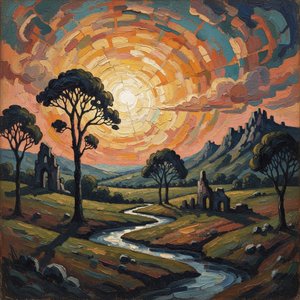
Lancaster’s formative years coincided with the ascendance of Impressionism, spearheaded by Claude Monet and Pierre-Auguste Renoir. However, unlike many artists of his era captivated solely by capturing fleeting visual sensations, Lancaster possessed a deeper yearning to explore psychological dimensions within his landscapes. He wasn't simply recording what he saw; he was striving to convey how it *felt*. This sensitivity is palpably present in “A Westmorland Landscape,” where muted greens and browns intertwine to form a scene rich with subtle gradations of light and shadow—a masterful demonstration of plein air painting techniques honed under Sickert’s guidance. Lancaster's meticulous blending of pigments, achieved through layering brushstrokes, meticulously built up texture and successfully captured the ephemeral beauty of twilight hours. The artist deliberately prioritized tonal harmony over bold color palettes, mirroring Turner’s seascapes and evoking a profound sense of melancholy alongside breathtaking visual splendor.
From Breton Shores to Intimate Portraits
Lancaster's artistic explorations extended beyond monumental vistas. He undertook extensive travels throughout Europe, particularly immersing himself in the Breton coastline – a region that would become a recurring motif in his oeuvre. These Breton scenes resonate with an arresting stillness and tranquility—a reflection of Lancaster’s own contemplative temperament. Drawing inspiration from Turner’s dramatic compositions, he skillfully utilized color palettes prioritizing tonal nuance over vibrant hues to convey emotion and atmosphere. The artist's meticulous brushwork captured the textures of weathered stone and turbulent seas alike, demonstrating a remarkable command of artistic technique. Furthermore, Lancaster showcased considerable talent as a portrait painter, producing emotionally resonant depictions of infants—most notably “The Bee.” Unlike the detached objectivity favored by some portraitists of his time, Lancaster approached these subjects with an empathetic gaze, capturing their vulnerability and innocence through textured brushwork and subdued coloration – a stylistic hallmark that subtly foreshadowed Expressionist tendencies.
Recognition & Legacy
Despite eschewing widespread acclaim during his lifetime—a circumstance attributable partly to the prevailing artistic climate of post-war Britain—Lancaster’s work gained considerable recognition posthumously. He was awarded the CBE in 1946 for services to art and education, acknowledging the esteem held by fellow artists and critics for his unwavering dedication to craft and artistic vision. Today, Lancaster's paintings reside primarily in private collections and are showcased at institutions such as Lancaster Town Hall Museum and Duke of Lancaster’s Own Yeomanry Museum—providing visitors with invaluable insight into his artistic legacy and its enduring influence on British landscape and portraiture traditions. His oeuvre stands as a testament to the transformative power of observation coupled with profound emotional engagement—a singular contribution to the history of British art.