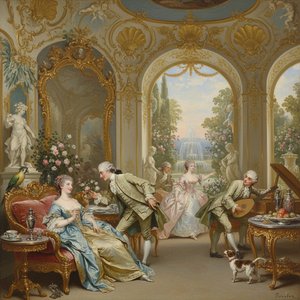
Simon François Ravenet: The Revivalist Engraver
Simon François Ravenet (b. 1706, Paris, d. 1774, London) stands as a pivotal figure in the history of English engraving and artistic revival during the Enlightenment era. Born into a family steeped in engraving tradition—his father was also a renowned engraver—Ravenet’s formative years were spent honing his craft under the tutelage of Jacques-Philippe Lebas in Paris, absorbing the foundational principles of line engraving before embarking on a transformative journey to London in 1743. This relocation marked not merely a geographical shift but a catalyst for artistic renewal, establishing Ravenet's School of Engraving and propelling him to the forefront of British art production.
Early Training & Parisian Influence
Ravenet’s initial training instilled in him a meticulous attention to detail and an understanding of classical engraving techniques—characteristics that would profoundly shape his subsequent artistic endeavors. Lebas's workshop fostered a dedication to accuracy and stylistic refinement, preparing Ravenet for the challenges of mastering the burgeoning English engraving scene. He diligently studied the works of Rembrandt and Rubens, adapting their compositional strategies and expressive qualities to his own engravings. This profound engagement with Baroque masters ensured that Ravenet’s artistic output would resonate with the intellectual currents of his time—a testament to his unwavering commitment to scholarly imitation and stylistic excellence.
London & The School of Engraving
Ravenet’s arrival in London coincided with a period of decline in British printmaking following the Baroque era. Recognizing this need for revitalization, he founded his school, attracting talented pupils like John Hall and William Wynne Ryland who would carry on his legacy and contribute to the stylistic evolution of English engraving. Ravenet championed line engraving as a medium capable of capturing subtle tonal variations and conveying nuanced emotional expression—a conviction that fueled his artistic innovation and solidified his position as a leader in British art production. His meticulous reproductions of paintings by other artists—a technique he perfected with unwavering precision—became synonymous with the revivalist spirit of the Enlightenment, demonstrating his profound understanding of artistic history and his dedication to preserving classical ideals.
Collaboration & Artistic Patronage
Ravenet’s association with William Hogarth proved invaluable, providing him with exposure to influential artistic circles and fostering a collaborative spirit that enriched his oeuvre. Hogarth recognized Ravenet's exceptional talent and encouraged him to explore new creative horizons—a partnership that yielded groundbreaking engravings depicting scenes of London life and social satire. Furthermore, he secured commissions from prominent patrons—including Joshua Reynolds—demonstrating the esteem in which his work was held during his lifetime. Reynolds appreciated Ravenet’s stylistic mastery and entrusted him with portraits of nobility—a commission that cemented Ravenet's reputation as one of England’s most respected engravers and solidified his place within the artistic elite of his era.
Notable Works & Artistic Style
Ravenet’s artistic style is characterized by exceptional precision, tonal subtlety, and a masterful command of line engraving—a technique he championed with unwavering conviction. He meticulously studied the works of Rembrandt and Rubens, adapting their compositional strategies and expressive qualities to his own engravings. His prints often exhibit a luminous quality achieved through careful shading and hatching, reflecting an admiration for the chiaroscuro effects favored by Baroque painters. Furthermore, Ravenet’s meticulous attention to detail—evident in his portraits and landscapes alike—underscored his commitment to capturing the nuances of human form and natural beauty.
- The Druids: Ravenet's engraving of “The Druids” exemplifies his stylistic prowess, skillfully recreating Zoffany’s celebrated painting with remarkable accuracy and conveying its atmosphere of intellectual curiosity and artistic contemplation.
- Joshua Reynolds Portrait: Ravenet’s portrait of Joshua Reynolds stands as a testament to his ability to capture the sitter's likeness and personality—a feat accomplished through painstaking observation and masterful engraving technique.
Ravenet’s legacy extends beyond his individual artworks; he profoundly impacted the artistic landscape of England, fostering a renewed appreciation for classical art forms and establishing a tradition of scholarly reproduction that endured for generations. His contributions to British engraving solidified his place as a visionary artist and a pivotal figure in shaping the aesthetic sensibilities of the Enlightenment. He was buried in old St. Pancras churchyard on April 6th, 1764, commemorated on the Burrett-coutts memorial alongside other eminent persons lost over time—a poignant reminder of his enduring influence on British cultural history.