


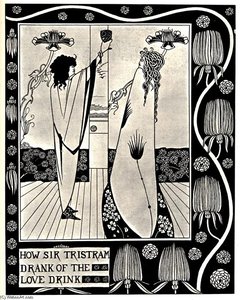

The Soul of the Line: Defining Romanticism in Illustration
To encounter a true Romantic illustration is to step beyond the veil of the mundane and into a realm where emotion dictates the movement of the hand. Unlike the rigid constraints of Neoclassicism, which sought perfection through symmetry and cold reason, the Romantic movement embraced the sublime—that breathtaking intersection of beauty and terror. In the delicate strokes of an illustrator’s pen, we find not merely a depiction of a subject, and certainly not a mere recording of fact, but a profound expression of the human spirit's deepest yearnings. The line itself becomes a vessel for longing, capable of conveying the turbulent winds of a storm or the quiet, melancholic stillness of a moonlit glade.
This era of visual poetics prioritized the subjective experience, inviting the viewer to feel rather than simply observe. Through the use of dramatic chiaroscuro and sweeping, organic forms, illustrators were able to evoke a sense of awe that transcends time. It is an art form rooted in the visceral; it speaks to our innate connection with nature’s grandeur and the haunting beauty of the unknown. When we study these works, we are not merely looking at ink on paper or pigment on canvas, but witnessing the very heartbeat of an era that dared to prioritize passion over precision.
Ethereal Narratives: The Symbiosis of Literature and Visual Art
The history of Romantic illustration is inextricably linked to the golden age of storytelling. There exists a sacred symbiosis between the written word and the illustrative image, where one breathes life into the other. Consider the exquisite collaborations found in Victorian book arts, such as Robert Anning Bell’s breathtaking decorations for Shakespeare’s The Tempest. Here, the lush, floral motifs and mother-tessellated details do not merely accompany the text; they expand the play's magical atmosphere, creating a multi-sensory experience that envelops the reader in Prospero’s enchanted isle.
This marriage of medium and message allows for a deeper immersion into the literary imagination. The illustrator acts as a visual translator, interpreting the metaphors of poets and the prose of novelists through color, shadow, and composition. When an artist captures the ethereal essence of a Shakespearean sprite or the brooding tension of a Gothic protagonist, they provide a visual anchor for the reader's wandering mind. This interplay creates a layered narrative depth, where the boundaries between what is read and what is seen begin to dissolve, leaving only the pure, unadulterated magic of the story.
Decadence and Dreamscapes: From Art Nouveau to Symbolist Mastery
As we transition from the high Romanticism of the early century into the fin de siècle, the illustrative style evolved into something even more intricate and psychologically complex. The emergence of Art Nouveau brought with it a fascination with organic fluidity and decadent ornamentation. We see this clearly in the striking works of Aubrey Beardsley, whose frontispieces for The Yellow Book utilized a stark, monochromatic palette to create an atmosphere of opulent mystery. His use of black and white—sharp, graphic, and unapologably bold—captured the era's fascination with symbolism and the darker, more enigmatic aspects of desire.
Parallel to this was the rise of Symbolism, where illustrators sought to represent ideas and emotions through metaphorical imagery. The works of Ethel Reed, particularly her illustrations for Arabella & Araminta Stories, exemplify this era’s ability to blend Art Nouveau design with a dreamlike, almost haunting quality. These artists moved away from literal representation toward a more stylized, decorative language that prioritized the evocative power of the image. In their hands, the illustration became a gateway to a subconscious landscape, populated by masked figures, mythical creatures, and landscapes that felt as though they were plucked directly from a fever dream.
The Tactile Emotion: Capturing Light, Texture, and Mood through Brushwork
While the graphic precision of printmaking holds its own charm, the true emotional zenith of the Romantic tradition is often found in the tactile depth of oil painting. The mastery of light—the ability to render a soft, diffused glow or a harsh, dramatic shadow—is what lends these works their lifelike vitality. In a hand-painted reproduction, one can perceive the intentionality behind every brushstroke. The use of impasto techniques creates a physical topography on the canvas, where the thickness of the paint catches the light, adding a dimension of reality that no digital print can replicate.
The chemistry of the medium itself plays a vital role in preserving this emotion. The careful application of oils, such as safflower for luminous whites, ensures that the brilliance of the highlights remains untarnished by time. When an artist works with 100% cotton canvas, layering pigments to create depth and tonal range, they are building a sensory experience. The viewer is invited to trace the movement of the brush, feeling the energy and the struggle of the creative process. It is this physical presence—the visible texture and the richness of color—that allows the artwork to pulse with a living, breathing emotion.
Curating the Sublime: Integrating Romantic Masterpieces into the Modern Interior
In the contemporary home, integrating works of such profound emotional weight requires a thoughtful approach to curation. A Romantic masterpiece should not merely occupy space; it should command it. Whether it is a large-format mural that recreates the grandeur of a historical ceiling or a multi-panel set that spans a wide architectural feature, these pieces serve as the soul of a room. The key to successful integration lies in balance—allowing the dramatic energy of the artwork to harmonize with modern textures and palettes without being overwhelmed by them.
For the discerning collector, art is an investment in atmosphere. When selecting pieces for a collection, one might consider the "period shift" approach, where even personal imagery is reimagined through the lens of historical masters. By placing a beautifully rendered, classically-styled work within a modern setting, a dialogue is created between the past and the present. This creates a sophisticated, timeless aesthetic that transcends fleeting trends, offering a sanctuary of beauty and reflection in an increasingly fast-paced world.
At AllPaintingsStore.com, we are dedicated to preserving this legacy of human creativity. Our mission is to make the grandeur of the Old Masters and the delicate beauty of Romantic illustrations accessible to collectors worldwide. Through our meticulous six-step process of hand-painted reproduction, we ensure that every brushstroke honors the original artist's intent, bringing the enchanting world of fine art into your personal sanctuary.


