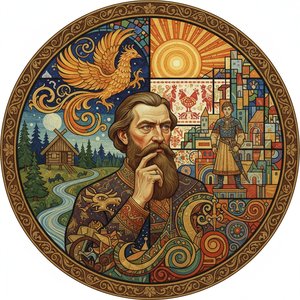
A Journey Through Silver and Shadow
Born in the twilight of the Russian Empire, Barbora Didžiokienė—once known as Varvara Gorochova—carried within her the profound cultural echoes of Saint Petersburg. Her early years were steeped in the artistic fervor of the Russian Silver Age, a period where symbolism and modernism danced in delicate tension. Moving to Lithuania in 1921, she brought with her a refined aesthetic shaped by the prestigious studios of her homeland, most notably under the guidance of the painter Vlad Didžiokas. This union was not merely personal but deeply artistic, as her formative training in technical drawing and the avant-garde influences of Proletkult schools provided the foundation for a style that would eventually enchant the Lithuanian art scene.
The Enchantment of the Miniature and the Doll
Didžiokienė’s true magic emerged through her mastery of tempera, a medium that allowed her to craft worlds both delicate and profound. Her work is famously characterized by an embrace of the decorative, where the complexities of linear perspective are cast aside in favor of stylized, flat forms and rhythmic lines reminiscent of the Art Deco movement. At the heart of her imaginative universe were her dolls—meticulous characters that served as much more than mere subjects. These figures were vessels for narrative and emotion, imbued with a symbolic weight that transformed simple canvases into epic tales of fantasy. In works such as
Lėlės smuklėje, one finds a whimsical exploration of life through the lens of the miniature, where every brushstroke contributes to a sense of staged, theatrical wonder.
The Stage and the Canvas
Beyond the intimate world of her doll paintings, Didžiokienė was a master of space and spectacle, finding a profound connection between the canvas and the theater. Her career as a scenographer allowed her to experiment with large-scale visual storytelling, crafting costumes and sets that mirrored the decorative elegance of her paintings. This theatricality bled into her broader repertoire, which included:
- Portraiture that captured the essence of her subjects through stylized features;
- Landscape studies that embraced a flattened, graphic quality;
- Caricatures and illustrations that showcased her sharp, observational wit;
- Religious themes rendered with a unique, decorative reverence.
A Lasting Legacy in Lithuanian Art
Though her life spanned eras of immense political and social upheaval—from the collapse of Imperial Russia to the complexities of the Soviet era—Didžiokienė’s artistic voice remained remarkably consistent in its pursuit of beauty and narrative depth. As a member of the Lithuanian Artists' Union from 1936, she solidified her place within the nation's cultural fabric. Her legacy is not found merely in museums, but in the enduring charm of her characters and the way she taught us to see the profound stories hidden within the small, the stylized, and the whimsical.