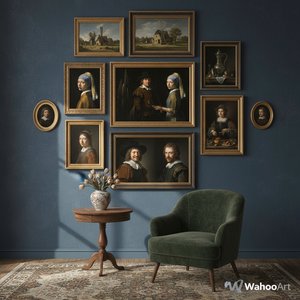
A Life in the Hague
Born in The Hague, Netherlands, Simon Ruys lived and worked during a period of significant diplomatic activity in the Dutch Republic. His presence in the city coincided with the height of his creative output, which spanned from 1670 until his death in 1690. He was a painter who learned his craft under the guidance of Jacques Vaillant, a connection that likely helped shape his approach to portraiture and the depiction of formal figures.
His work reflects the social hierarchies of the late seventeenth century. He focused on the likenesses of individuals who held weight in the political and social circles of the time. Through his brush, the quiet dignity of his subjects was captured, often placing them within a context of status and duty.
The Art of the Portrait
Ruys found his niche in capturing the likenesses of the influential. His technique involved working with oil paint on panel, a method that allowed for a precise rendering of texture and light. One of his most significant surviving works is a portrait of Johannes Camprich van Cronefelt, a man of high standing who served as the Imperial German Ambassador to The Hague and was a Knight of the Order of St. Maurice and St. Lazarus. This piece, held in the Rijksmuseum in Amsterdam, provides a window into the formal presentation of the era.
The details of his subjects' lives are often embedded in the very way they are painted. His compositions frequently included:
- The specific insignia and honors of the sitter, such as the robes of a knight.
- The subtle textures of fabric and the weight of ceremonial attire.
- The use of landscape elements, such as mountains or rivers, to provide a sense of place or character.
Legacy and Recognition
While the name Simon Ruys may not be a household word today, his contributions to the Dutch portrait tradition remain preserved in major collections. His ability to translate the presence of a diplomat or a nobleman onto a wooden panel ensured that his subjects would be remembered by those who studied their likenesses. His work survives not only in the original oil paintings but also through the engravings of his compositions, which helped spread the images of his subjects far beyond the walls of the Hague.
Pitanja i odgovori
Mogu li posjetiti virtualni muzej djela umjetnika Simon Ruys?
Djela umjetnika Simon Ruys možete pogledati u 3D galeriji na njegovoj stranici 3D galerija.
Mogu li pregledavati djela umjetnika Simon Ruys prema umjetničkom pravcu?
Umjetnički pokreti u kojima je Simon Ruys stvarao možete vidjeti na stranici Svi umjetnički pravci, koja grupirira djela prema umjetničkom pokretu.
Mogu li proučiti način na koji Simon Ruys koristi boju u svim svojim djelima?
Upotrebu boje u djelima umjetnika Simon Ruys koja su navedena na ovaj web-mjesto moguće je proučiti na umjetnikovoj stranici Genom palete.
Mogu li istražiti djela umjetnika Simon Ruys prema ključnim riječima?
Djela umjetnika Simon Ruys možete istražiti putem ključnih riječi na njegovoj stranici Pretraživanje po ključnim riječima, gdje svaka ključna riječ grupirala pripadajuća djela.