The Poetry of Grey: Discovering the Soulful Essence of the Hague School
 Capturing the Grey Light: A Masterclass in the Atmospheric Hague School Art Movement
The Essence of Atmosphere: Defining the Hague School Movement To step into a landscape painted by the Hague School is to enter a world where the air itself possesses weight, moisture, and a profound sense of quietude. Emerging in the mid-19th century...
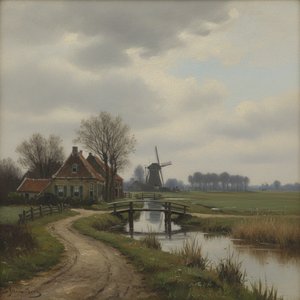
To step into a landscape painted by the Hague School is to enter a world where the air itself possesses weight, moisture, and a profound sense of quietude. For those of us who have spent decades finding solace in the soft edges of a canvas, there is something deeply intimate about this mid-19th-century movement. It was not merely an era of painting, but a way of seeing—a way of feeling the damp, misty reaches of the Dutch countryside where the boundary between earth and sky often dissolves into a seamless, silvery haze. These artists were not content with documenting scenery; they were translating the very breath of the Low Countries onto canvas, capturing the ephemeral soul of a nation through a lens of quiet contemplation.
There is a certain melancholy, yet a profound peace, found in these works. Unlike the vibrant, sun-drenched celebrations of the Mediterranean, the Hague School finds its heartbeat in the overcast. It is a movement that invites us to slow down, to breathe with the rhythm of the tides and the swaying reeds. In every brushstroke, there is an invitation to find beauty not in the spectacular or the bright, but in the subtle, the muted, and the understated. It is a celebration of the quiet moments that often go unnoticed in the rush of modern life.
Beyond the Golden Age: The Rise of Realism and Atmospheric Truth
 The Hague School: Realism, Atmosphere & the Dawn of Dutch Impressionism
The Rise of Realism: Challenging Tradition in Dutch Art Wikipedia: Hague School The Hague School (Dutch: Haagse School) is a group of artists who lived and worked in The Hague between 1860 and 1890. Their work was heavily influenced by the realist pa...
For centuries, Dutch art had been synonymous with the meticulous, hyper-detailed precision of the Golden Age masters. We remember the sharp clarity of their everyday scenes and biblical narratives, a tradition that celebrated technical perfection. However, by the mid-19th century, a quiet revolution was brewing in The Hague. A new generation of artists began to challenge these established norms, seeking a more honest depiction of the world—a desire to capture not just what things looked like, but how they felt.
Influenced heavily by the French Barbizon school and the realist pioneers like Millet, these painters turned their gaze toward the humble and the immediate. They moved away from idealized, grand narratives and instead embraced the ruggedness of the coastline, the windswept polders, and the rhythmic toil of rural life. This shift was not a sudden upheaval but a gradual, soulful transition toward authenticity. By prioritizing mood over anatomical or architectural accuracy, they pioneered an emotive style that resonated with the growing social consciousness of their era, finding dignity in the landscape and the ordinary lives of those who inhabited it.
A Palette of Mist and Moonlight: Mastering Tonalism and Light
 A Dutch Road
A Dutch Road by Anton Mauve: Echoes of Impressionism in Rural Tranquility Led by Anton Mauve, the group of Dutch painters known as the Hague School distinguished itself by its exceptional rendering of moody atmosphere and light. As a Dutch critic wro...
The true protagonist of any Hague School masterpiece is the light—specifically, the nuanced, monochromatic spectrum known as the grey light. While other movements chased the saturated hues of a summer afternoon, the masters of The Hague found infinite complexity within a palette of silver, pearl, slate, and muted ochre. This was not a lack of color, but rather an expansion of it. They mastered the art of tonalism, using subtle shifts in value to create depth and dimension amidst a seemingly monochromatic landscape.
This mastery allowed them to render the atmosphere with breathtaking subtlety. One can almost feel the moisture in the air when viewing their works; the light filters through heavy, Atlantic cloud cover, creating a sense of soft, diffused radiance. They utilized atmospheric perspective, placing distant objects in paler, hazier hues to simulate vastness and depth. In these paintings, the light does not simply illuminate the subject; it becomes the subject itself, wrapping the landscape in a cloak of pearlescent mist that evokes a sense of timelessness and eternal calm.
Masters of the Dutch Landscape: From Anton Mauve to Jan Weissenbruch
 A landscape with a windmill, towards twilight
Discover Jan Weissenbruch’s ‘A Landscape with a Windmill’. Atmospheric Hague School watercolor captures twilight Dutch scenes – serene beauty & romantic mood.
The movement was anchored by several brilliant minds, each bringing a unique sensitivity to the Dutch terrain. Anton Mauve stands as perhaps the most iconic figure, his work such as A Dutch Road exemplifying the "poetry of gray." His canvases capture the quintessential rural Holland—a solitary road winding into the distance under an overcast sky, where the lines are loose and expressive, suggesting movement rather than rigid detail. Alongside him, Jacob Maris brought a classical interpretation to themes of fishing boats and river scenes, his work often regarded as the perfect embodiment of the Hague School's grey period.
We also find the serene, quiet mastery of artists like Jan Willem van Borselen, whose watercolors offer glimpses into the tranquil beauty of marshes and windmills with a delicate, luminous touch. Even the younger generation, such as Jan Weissenbruch, continued this legacy, capturing the changing weather and every possible nuance of green and grey in his landscapes. These artists, though sometimes overshadowed by the later Impressionists, remained true to the tonality of their homeland, ensuring that the spirit of the Dutch countryside would be preserved through their dedicated, outward-looking practice.
The Legacy of the Grey School: Influencing the Dawn of Impressionism
--- title: Hague School: 12 works - Google Arts & Culture url: https://artsandculture.google.com/story/hague-school-12-works/qwWhre88nAouNA hostname: google.com description: A slideshow of artworks auto-selected from multiple collections sitename: Go...
Though often categorized as a precursor to Impressionism, the Hague School holds a distinct and vital place in art history. They provided the foundational bridge between the structured Realism of the mid-19th century and the light-drenched experiments of the late 19th century. By focusing on the sensation of the moment and the shifting patterns of light, they paved the way for the French Impressionists to further explore the ephemeral nature of perception.
The legacy of these Dutch masters lives on in our appreciation for atmosphere and mood. They taught us that there is profound beauty in the shadows, that a grey sky can be as emotive as a sunset, and that truth is often found in the softest edges. For the collector and the lover of art, the Hague School remains a sanctuary of peace—a reminder that even in the most muted tones, there is a vibrant, enduring soul waiting to be discovered.
At AllPaintingsStore.com, we share this lifelong passion for the emotive power of light and atmosphere. We specialize in bringing the textures and souls of these historical movements into the modern home through exquisite, hand-painted oil reproductions. Whether you seek to capture the misty tones of the Hague School or the sun-drenched strokes of Monet, our master artists work on 100% cotton canvas to ensure every brushstroke carries the weight and beauty of the original masters.