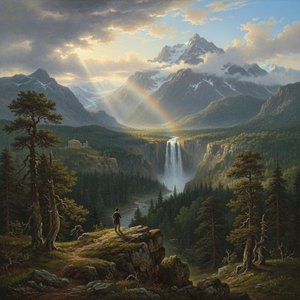
Henry Gibson Duguid: A Vision of Scottish Landscape
Henry Gibson Duguid (1805 – present) stands as a singular figure in 19th-century British landscape painting, particularly celebrated for his meticulous depictions of Scotland’s dramatic highlands and architectural grandeur. Born into a family steeped in artistic tradition—his father was a portrait painter—Duguid embarked on a career dedicated to capturing the sublime beauty of his homeland with unwavering precision and sensitivity. While biographical details remain somewhat sparse, his artistic output speaks volumes about his profound connection to the Scottish landscape and its cultural heritage. His early life unfolded in Edinburgh, where he received a comprehensive artistic education fostered by his father’s influence—a formative experience that instilled within him an appreciation for classical art and portraiture. Recognizing the transformative potential of landscape painting to convey emotion and grandeur, Duguid swiftly transitioned from formal training to mastering this captivating genre. He diligently studied geological formations and atmospheric conditions, mirroring the approach championed by luminaries like Hudson River School artists, ensuring his paintings resonated with authenticity and spiritual depth. Among Duguid’s most revered creations are “Old Trinity Church, Edinburgh,” a masterful portrayal of the historic edifice nestled amidst rolling hills—a testament to his ability to integrate architectural detail with expansive vistas. Equally impressive is "The Landing Place, Stirling," capturing the serene beauty of Loch Lomond and its surrounding Ochil Hills, demonstrating Duguid’s mastery of tonal gradation and atmospheric perspective. Furthermore, “Castlehill, Edinburgh, As It Was before Alterations,” offers a poignant glimpse into Edinburgh's past, meticulously documenting the castle hill’s appearance prior to significant renovations—a remarkable feat of topographical accuracy. These paintings exemplify his commitment to preserving Scotland’s visual heritage for posterity. The influence of the Hudson River School is palpable in Duguid’s artistic vision; he embraced techniques mirroring those favored by Cole, Church and Durand – prioritizing tonal harmony and dramatic lighting to inspire awe and contemplation. Like these contemporaries, Duguid sought to elevate landscape art beyond mere representation, aiming instead to convey profound spiritual truths about humanity's relationship with nature. His meticulous glazing technique—applying thin washes of color over multiple coats—allowed him to faithfully reproduce textures and achieve luminous effects, mirroring the stylistic hallmarks of the movement. Duguid’s legacy extends far beyond his individual artworks; he solidified Scotland’s place within the broader artistic discourse of the Romantic era. Today, his paintings continue to inspire admiration for their technical brilliance and emotional resonance—serving as a poignant reminder of a time when artists endeavored to capture not just what they saw but also what they felt – conveying a deep reverence for the sublime beauty of the Scottish wilderness and its enduring significance in shaping artistic expression. His unwavering dedication to realism ensured that his work would endure as an emblem of Romantic idealism and Scotland’s timeless allure.Kérdések és válaszok
Honnan származik Henry Gibson Duguid?
Henry Gibson Duguid Skózia-ban született.
Hol tekinthetném meg Henry Gibson Duguid összes művét?
Henry Gibson Duguid minden alkotása megtekinthető a ez a weboldal oldalán, az alkotó Összes műalkotás oldalán keresztül.
Megvizsgálhatom Henry Gibson Duguid színhasználatát az összes művében?
Henry Gibson Duguid műveleteinek színprofilja a művész Paletta Genom oldalán tekinthető meg.