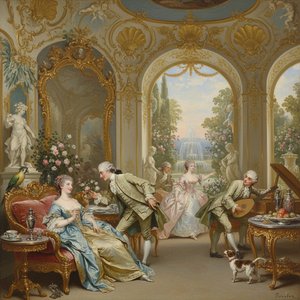
The Quiet Master of Rococo Portraiture
Henry Pickering, born around 1720, remains a somewhat elusive figure in the annals of British art history—a testament to his understated brilliance and the tendency of aristocratic patronage to favor those who excelled without seeking grand acclaim. Unlike many of his contemporaries who jostled for prominence amidst the flamboyant excesses of the Rococo era, Pickering cultivated a reputation for meticulous craftsmanship and refined elegance. He produced portraits that captured not merely likenesses but also subtle expressions of character and social standing, weaving a narrative of dignity through every brushstroke.
His artistic journey began in London, where he apprenticed under Jonathan Richardson Sr., a pivotal figure in establishing the English portrait tradition. Richardson’s influence instilled in Pickering a deep understanding of chiaroscuro—the dramatic interplay of light and shadow—a technique that would become a hallmark of his oeuvre. This stylistic approach was not merely about visual spectacle; it served to convey psychological depth, mirroring the prevailing philosophical currents of Enlightenment thought which emphasized reason and observation alongside emotion.
Refinement in Detail and Character
Pickering’s artistic output focused primarily on commissioned portraits of prominent families and individuals, notably members of the aristocracy and gentry. He possessed a remarkable ability to distill complex personalities into carefully rendered canvases, prioritizing subtlety and nuance over ostentation. His work often avoided the garishness found in some Rococo works, opting instead for a sophisticated restraint that allowed the subject's true essence to emerge from the canvas.
Consider his depiction of Mary Greame (1682–1767), completed in 1763. The painting’s muted palette—dominated by browns and creams—contrasts sharply with the opulent interiors typical of the period, creating a contemplative mood that reflects Greame's dignified demeanor. Details such as the lace collar and the embroidered shawl speak volumes about her social status and underscore Pickering’s skill in conveying visual cues beyond mere facial features. This mastery extended to his depictions of other notable figures, including:
- Sir Jacob Downing: A classic 18th-century oil painting showcasing aristocratic style and meticulous detail.
- Possibly Sir Thomas Hesketh: An elegant portrait that captures the historical grandeur of the period through refined textures.
- Portrait of a Lady: A quintessential example of his ability to evoke elegance through soft light and delicate composition.
Legacy and Historical Significance
Though he passed away around 1771, Pickering's contribution to the British portraiture tradition remains significant. He represents a bridge between the formal traditions established by his mentor and the more psychologically nuanced portraiture that would follow in the later Georgian era. His ability to balance the decorative requirements of the Rococo style with the intellectual rigor of the Enlightenment allowed him to create works that are both aesthetically pleasing and deeply human.
Today, his works serve as vital windows into the social fabric of 18th-century Britain. Through his careful rendering of textiles, light, and expression, Pickering preserved the likenesses of a bygone era, ensuring that the quiet dignity of his subjects continues to resonate with viewers centuries later. His legacy is found not in loud declarations of fame, but in the enduring, silent power of his meticulously crafted portraits.
Kérdések és válaszok
Van-e kronológiai ismertetés Henry Pickering életművének?
Henry Pickering munkásságának időrendi áttekintése a művész Krónika oldalán érhető el, ahol az alkotások fejezetről fejezetre, a készítés sorrendjében követhetők egymást.
Milyen színeket használt leggyakrabban Henry Pickering?
Henry Pickering műveleteinek színprofilja a művész Paletta Genom oldalán tekinthető meg.
Hol találhatók statisztikák Henry Pickering műveire vonatkozóan?
Henry Pickering Statisztikák oldala a ez a weboldal felületén található műalkotásokból számított statisztikákat mutatja be.