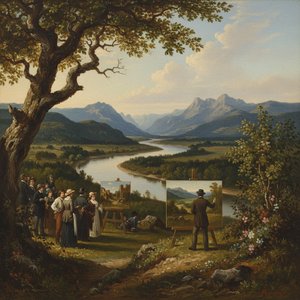
A Visionary of the Danish Golden Age
Jørgen Valentin Sonne (1801–1890) remains a luminous figure in the tapestry of Danish Romanticism, a painter whose brush captured not merely the landscapes of his homeland but the very soul of a nation in transition. Born in Birkerød, Sonne was the son of Jeppe Sonne, a skilled copperplate engraver for the Royal Mint. This early exposure to the precision of engraving likely planted the seeds of the meticulous detail and structural clarity that would later define his mastery. While his initial inclinations leaned toward the discipline of the military—leading him briefly to the Royal Danish Military Academy—the call of the canvas proved irresistible. Abandoning the sword for the brush, he sought refuge in the halls of the Royal Danish Academy of Fine Arts, embarking on a journey that would elevate him from a student of tradition to a pioneer of genre and landscape painting.
His formative years were shaped by an rigorous academic apprenticeship, most notably under Christian David Gebauer. In the quiet studios of Copenhagen, Sonne immersed himself in the study of the Old Masters, particularly the Dutch masters, whose command of light and atmosphere left an indelible mark on his developing technique. This period of intense observation allowed him to master the art of replication, a necessary precursor to his later ability to breathe life into original compositions. His thirst for broader horizons eventually led him to Munich, where he studied under the influential history painter Peter von Cornelius. The rugged, majestic vistas of the Bavarian Alps provided a dramatic backdrop for his early explorations, teaching him how to weave monumental scale with intimate, human narratives.
The Roman Influence and the Light of Italy
Perhaps the most transformative chapter in Sonne’s life began with a travel stipend that whisked him away to Italy. For ten years, the sun-drenched landscapes and ancient ruins of Rome served as his primary muse. It was here that his style matured into something truly singular; the academic rigor of his Danish training fused with the vibrant, warm luminosity of the Mediterranean. He became a chronicler of Italian life, capturing everything from the bustling energy of Carnival in Rome to the quiet, pastoral rhythms of Roman villages. His works from this period, such as Tyrehidsning i en romersk Landsby, demonstrate a profound ability to balance historical weight with a sense of immediate, lived experience.
This Italian sojourn did more than refine his palette; it expanded his thematic repertoire. While he remained deeply connected to his Danish roots, the classical light of Italy allowed him to approach his subjects with a new level of atmospheric depth. He learned to manipulate shadows and highlights to evoke emotion, turning a simple forest path or a coastal view into a stage for poetic reflection. This period of intense observation ensured that when he eventually returned to Northern Europe, he brought with him a sophisticated understanding of how light could define character and landscape alike.
Legacy of a National Chronicler
Upon his return to Denmark, Sonne’s significance within the national art scene became undeniable. In 1846, his talent was formally recognized when he was elected a member of the Royal Danish Academy of Fine Arts. His oeuvre became a vital record of the Danish identity, particularly through his celebrated battle scenes and his tender depictions of the peasantry. He possessed a rare gift for elevating the everyday—the toil of the farmer, the movement of a crowd, or the quietude of a rural scene—to the level of high art. His paintings served as a bridge between the grand historical narratives of the past and the burgeoning national romanticism of his era.
The enduring impact of Jørgen Valentin Sonne can be seen in the way he harmonized the monumental with the minute. His ability to capture the sweeping drama of history alongside the delicate textures of nature ensured his place in the pantheon of great Danish painters. Today, his works reside in prestigious collections such as the Statens Museum for Kunst, serving as enduring testaments to a life spent chasing the light and documenting the heartbeat of a culture. Through his eyes, we see a world where history, landscape, and humanity are inextricably linked by the golden thread of artistic truth.