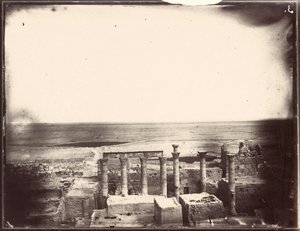
A Life of Discovery and Documentation
Louis Vignes was far more than a mere observer of the world; he was a man whose life was defined by the dual callings of naval discipline and an exquisite, amateur passion for photography. Born in Bordeaux, France, Vignes followed a distinguished path within the French Navy, rising through the ranks to achieve the prestigious status of Vice Admiral. While his professional identity was anchored in the structured world of maritime service and naval administration, his soul found expression through the lens of a camera. His journey through the Mediterranean—spanning from the south of France to the shores of Lebanon—allowed him to capture the ephemeral beauty of ancient civilizations before they were lost to time.
His photographic endeavors, though often considered an aside to his naval career, possess a profound documentary quality that transcends simple snapshots. Between 1859 and 1862, while sailing the Mediterranean, Vignes produced a series of fifty-two negatives on small format paper, creating salted paper prints that documented landscapes, monuments, and sacred sites in Morocco, Sicily, Beirut, and Lebanon. This period of exploration laid the groundwork for his most significant contribution to the visual record of antiquity.
The Lens of Antiquity
The true significance of Vignes’ work emerged through his collaboration with the Duc de Luynes during an ambitious archaeological expedition in 1864. Tasked with documenting the ruins of Lebanon and Palestine, Vignes utilized both the calotype process and the collodion wet plate process to capture the grandeur of sites such as Palmyra and the Temple of Bel. His images are not merely technical records but are imbued with the evocative spirit of Romanticism, offering a poignant glimpse into a world of ancient Roman religious architecture that was already beginning to fade.
In his compositions, Vignes demonstrated a remarkable ability to weave human presence into the vastness of historical decay. By strategically placing figures within the frame—some in sharp focus and others receding into the distance—he created a sense of depth and scale that emphasized the monumental nature of the ruins. His work often focused on:
- The Temple of Bel: Capturing the intricate details of the cella and the majestic, weathered stone of this sacred space.
- Colonnade Street: Utilizing dramatic lighting and linear perspective to showcase the textures of Roman architectural remnants.
- Panoramic Landscapes: Documenting the sweeping vistas of Beirut and the surrounding archaeological sites with a modern, documentary eye.
Through the use of black-and-white palettes, Vignes stripped away the distractions of color, allowing the viewer to focus on the raw textures of stone and the interplay of light and shadow. His photographs serve as a bridge between the scientific necessity of archaeological documentation and the emotional resonance of the sublime, ensuring that the majesty of these ancient ruins remains etched in the collective memory of the modern age.
アーティストへのQ&A
Louis Vignesの作品を技法別にまとめて閲覧できる場所はどこですか?
技法別一覧では、Louis Vignesの作品を技法別にまとめています。
Louis Vignesの出身地(都市および国)はどこですか?
Louis Vignesは、FranceのBordeauxで生まれました。
カタログ内で閲覧可能なLouis Vignesの作品数はいくつですか?
全作品一覧ページでは、Louis Vignesによる作品数 9点点のアートワークをご覧いただけます。