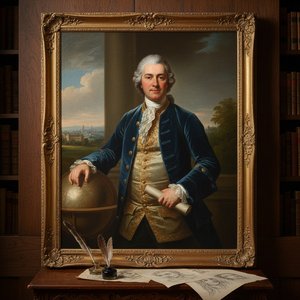
The Precision of the Miniature and the Scale of the Portrait
Thomas Clement Thompson possessed a technical discipline that allowed him to navigate the drastic shift from the intimate to the monumental. He began his career in Belfast and Dublin, focusing on the meticulous demands of portrait miniatures. This early period required a specific kind of control, a ability to render the subtle textures of skin and fabric within a tiny, restricted space. By the time he moved his studio to London around 1817, he had abandoned the miniature in favor of large-scale portraiture. This was not a mere change in size, but a calculated expansion of his professional reach. He became a regular fixture at the Royal Academy, exhibiting there until 1847, and his ability to capture the likenesses of high society and political figures, including George IV, secured his reputation in the competitive London art scene.
His career was defined by several distinct phases of professional activity:
Institutional Influence and Artistic Evolution
Thompson’s importance is cemented by his institutional standing. As a founder member of the Royal Hibernian Academy, he helped establish the formal structures of Irish art during a period of significant transition. His training at the Dublin Society Schools, which began in 1796, provided the academic foundation necessary to move from the delicate precision of his early work to the more expansive requirements of landscape and large-scale portraiture. While his primary focus remained the human subject, his forays into landscape painting demonstrated a command over atmospheric perspective and the play of light. He moved his residence from London to Cheltenham in 1848, marking the final chapter of a career that spanned the most influential art circles of the United Kingdom.
His technical legacy is found in the specific way he handled light and form. Whether working on a small scale or a large canvas, Thompson maintained a rigorous approach to draughtsmanship. He did not rely on vague impressions; his work was built on a foundation of tonal manipulation. This discipline allowed him to move between the private, quiet dialogue of a miniature and the public, commanding presence of a formal portrait. He died in Cheltenham from bronchitis, leaving behind a body of work that reflects the shifting aesthetic demands of the nineteenth century.