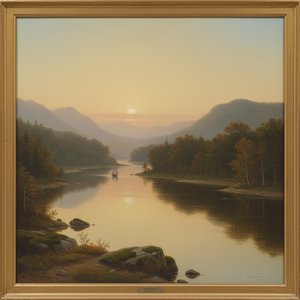
The Dual Legacy of the Big Unit: From Diamond Dominance to Canvas Serenity
Before he was a master of light and texture on canvas, Randall David Johnson was a force of nature on the baseball diamond. Known globally by his moniker, “The Big Unit,” Johnson’s presence was defined by an imposing physical stature and a legendary, blistering fastball that commanded the attention of millions. Born on September 10, 1963, in Walnut Creek, California, his journey began not with a paintbrush, but with the rhythmic precision of professional athletics. His career, spanning twenty-two seasons across iconic franchises like the Seattle Mariners and Arizona Diamondbacks, was marked by an unparalleled intensity. He achieved the rare pinnacle of pitching perfection, famously throwing a perfect game in 2004, a feat that mirrored the absolute focus and control he would later bring to his artistic endeavors.
The transition from the high-stakes arena of Major League Baseball to the quietude of fine art may seem like a profound departure, yet for Johnson, the two worlds share a common thread of disciplined mastery. The same unwavering commitment that earned him five Cy Young Awards and a place in the Hall of Fame now finds expression through the delicate application of pigment. As he moved away from the roar of the stadium crowds, Johnson sought refuge in the tranquil landscapes of Lake George. It was here, amidst the shifting shadows and shimmering waters, that his second act truly began. The aggression of the pitcher evolved into the sensitivity of the Impressionist, trading the strike zone for the subtle nuances of color and light.
A Symphony of Light and Landscape
Johnson’s artistic evolution is deeply rooted in the Impressionistic tradition, where the goal is not merely to replicate a scene, but to capture its ephemeral essence. His work is characterized by a profound sensitivity to how light interacts with the natural world, particularly during those fleeting moments of dawn and dusk. Through meticulous brushwork, he creates textured surfaces that invite the viewer to feel the humidity of a summer afternoon or the crispness of an autumn breeze. His paintings are less about static scenery and indeed more about the emotional resonance of a place.
In his notable series, one can observe a deep connection to his surroundings and a reverence for historical subjects. His portfolio includes evocative pieces such as:
- Study, Harbor Island, Lake George: A masterful exploration of water and reflection that showcases his ability to manipulate light.
- Sojourner Truth: A powerful portrait that demonstrates his capacity for capturing the dignity and spirit of historical figures.
- Oak: A study in strength and endurance, mirroring the resilience found in both nature and a life of professional excellence.
The technique employed by Johnson involves a sophisticated blending of strokes to achieve a sense of movement and depth. By focusing on the interplay of color, he manages to convey the atmospheric weight of the landscapes he inhabits. This dedication to capturing the "feeling" of a landscape allows his work to transcend simple representation, turning each canvas into a window through which the viewer can experience the serene beauty of the American wilderness.
The Intersection of Precision and Emotion
The historical significance of Randall David Johnson’s dual career lies in the unexpected harmony between his two identities. While his baseball career was defined by the precision of a strike, his art is defined by the fluidity of a stroke. There is a poetic symmetry in how a man who once mastered the physics of a moving ball now masters the physics of light hitting a surface. His life serves as a testament to the idea that greatness is not confined to a single discipline; rather, the discipline required for one can become the foundation for another.
Ultimately, Johnson’s work stands as a bridge between the adrenaline-fueled world of professional sports and the contemplative realm of fine art. He has successfully navigated the transition from being an icon of physical prowess to becoming a creator of visual poetry. For those who follow his journey, whether through the archives of baseball history or the galleries of contemporary landscape painting, the common denominator remains a relentless pursuit of excellence and a profound respect for the beauty found in both strength and stillness.