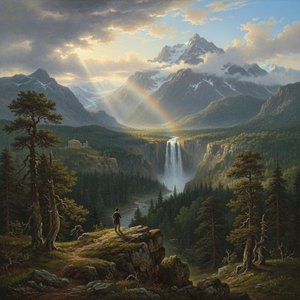
From Floral Delicacy to Alpine Grandeur
Born into a Viennese family that specialized in the delicate craft of artificial flowers, Anton Hansch’s early artistic sensibilities were rooted in the meticulous and the minute. Before he became a master of the sweeping mountain vista, his hands were trained in the subtle textures of petals and silk, a background that perhaps gifted him with an unparalleled eye for naturalistic detail. His formal education at the Vienna Academy of Fine Arts, spanning from 1826 to 1836, brought him under the tutelage of Joseph Mössmer, a mentor who would instill in him the foundational discipline required to capture the world's more rugged complexities. This period of rigorous training saw Hansch moving away from the delicate art of flower painting toward the burgeoning Romantic movement, where the focus shifted from the small-scale beauty of a bloom to the overwhelming majesty of the landscape.The Pursuit of the Sublime
As his wanderlust took him across the landscapes of Germany, Belgium, Switzerland, and Italy, Hansch’s style underwent a profound metamorphosis. His early works, steeped in the structured elegance of Baroque Classicism, gradually surrendered to a more visceral, naturalistic tradition. He became an explorer of light and atmosphere, particularly within the breathtaking reaches of the Austrian Alps and Styria. In these high altitudes, Hansch found his true subject: the sublime. His canvases began to breathe with the golden warmth of sunlight hitting granite peaks and the cool, misty shadows of alpine valleys. He moved beyond mere topographical accuracy to achieve a heroic, idealized style that captured not just what the eye saw, but what the soul felt when confronted by the infinite scale of nature. This artistic evolution was characterized by several key shifts:- A transition from Baroque precision toward a more emotive Naturalism.
- The mastery of subtle nuances in light and color to convey emotional resonance.
- An expansion into larger, more ambitious formats that captured panoramic vistas.
A Lasting Impression on the Austrian Landscape
Hansch’s career was punctuated by significant accolades that cemented his status within the European art community. From winning first prize for landscape painting at the Vienna Academy in 1839 to receiving prestigious honors like the Grand Court Prize, his ascent was as steady as the mountains he painted. His ability to attract the attention of the imperial family—notably through works commissioned by Archduke Franz Karl—placed him at the very heart of Austrian cultural life. Today, his legacy is preserved in the hallowed halls of the Kunsthistorisches Museum and the Salzburg Museum, where his panoramic vistas continue to invite viewers into a world of eternal alpine splendor. His work remains a testament to an era when art sought to bridge the gap between scientific observation and the profound, spiritual awe inspired by the natural world.질의응답
특정 팔레트의 Anton Hansch 작품은 어떻게 찾을 수 있나요?
Anton Hansch의 작품은 작가의 컬러 팔레트별 페이지에서 컬러 팔레트별로 둘러보실 수 있습니다.
Anton Hansch 작가의 출신 국가는 어디인가요?
Anton Hansch은(는) Austria에서 태어났습니다.
Anton Hansch의 출생지와 출생 연도는 언제인가요?
Anton Hansch은(는) 1813년 Vienna에서 태어났습니다.