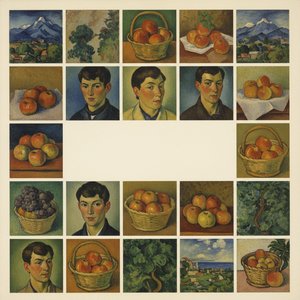
The Luminous Sands of an Orientalist Visionary
Born in the vibrant landscape of New York City in 1860, Charles James Theriat emerged as a master of light and atmosphere, carving a unique niche within the prestigious tradition of Orientalism. While many of his contemporaries sought the exotic through staged studio compositions or bustling urban bazaars, Theriat possessed a restless, wandering spirit that drew him toward the profound stillness of the desert. His journey was one of constant movement, from the bustling streets of his American youth to the rigorous academic halls of Paris, eventually leading him to the sun-drenched expanses of North Africa. This migration of both person and purpose allowed him to develop a style that was less about the spectacle of the "exotic" and more about the spiritual resonance of the landscape itself.
Theriat’s artistic foundation was forged in the crucible of the French academic tradition. After moving to Europe as a young boy, he sought formal instruction at the renowned Académie Julian in Paris, studying under masters such as Jules-Joseph Lefebvre and Gustave-Clarence-Rodolphe Boulanger. This period of intense training provided him with the technical precision required to render the complex textures of sand, stone, and fabric. However, it was his departure from the studio that truly defined his legacy. Unlike many urban-focused Orientalists who preferred the intricate details of harem interiors, Theriat became a pioneer of plein air painting in the Sahara. He sought the solitude of the desert reaches, particularly around Biskra and Touggourt, where he could witness the raw, unadulterated interplay of light and shadow across the Algerian landscape.
A Symphony of Light and Solitude
The true essence of Theriat’s oeuvre lies in his ability to capture the ephemeral. His work is characterized by an extraordinary sensitivity to the dazzling brilliance of the North African sun and the vast, overwhelming presence of the sky. In many of his most celebrated canvases, human or animal life is secondary—often entirely absent—leaving the viewer alone with the immense, silent architecture of the dunes. He possessed a singular talent for portraying the "dazzle" of whitewashed buildings in oasis towns, using light not merely as an illuminator but as a physical force that can dissolve edges and transform solid structures into shimmering visions of heat and dust.
His technical approach blended the meticulousness of his academic training with an Impressionistic fascination with atmosphere. Through his brush, the nomadic life of the desert was rendered with a profound respect for its quiet dignity. Whether he was painting the stark beauty of a desert expanse or the intricate textures of a tent, his work maintained a sense of rhythmic harmony. This mastery earned him significant acclaim on the international stage, as he exhibited his works at major exhibitions in Chicago, Berlin, Dresden, and Paris. His ability to translate the heat and stillness of the Sahara into a medium of oil and watercolor allowed him to win prestigious medals at both the Paris and Buffalo expositions, cementing his reputation as a premier chronicler of the desert's soul.
Legacy of the Desert Wanderer
As the twentieth century progressed, Theriat’s work remained a testament to a vanishing era of exploration and artistic discovery. His later years, spent in the quietude of Le Mée near Barbizon, reflected a life that had successfully synthesized the rigorous discipline of the French Academy with the boundless freedom of the open desert. He left behind a body of work that serves as both a historical record of North African landscapes and a deeply personal meditation on the concept of space and light.
The enduring significance of Charles James Theriat can be found in the following artistic contributions:
- Mastery of Atmospheric Perspective: His ability to use light to create depth and a sense of infinite distance within desert landscapes.
- Pioneering Plein Air Orientalism: Moving the focus of the genre away from staged interiors toward the authentic, unpeopled beauty of the natural world.
- Technical Synthesis: The seamless integration of academic realism with the expressive, light-driven sensibilities of late 19th-century painting.
- Cultural Documentation: Providing a luminous visual record of the architecture and environments of the Algerian oases during a transformative historical period.
질의응답
Charles James Theriat 작가는 어떤 사조에 참여했나요?
Charles James Theriat 작가가 활동했던 예술 사조는 작품을 사조별로 분류하여 보여주는 작가의 모든 사조 페이지에서 확인하실 수 있습니다.
Charles James Theriat의 모든 작품을 어디에서 볼 수 있나요?
본 웹사이트에 등록된 Charles James Theriat의 모든 작품은 작가의 모든 작품 보기 페이지에서 확인하실 수 있습니다.
Charles James Theriat의 경력은 어떻게 시기별로 구분되어 있나요?
Charles James Theriat의 예술적 여정은 연대기 페이지에서 시기별로 펼쳐집니다. 이곳에서는 작가의 활동 시기를 장(chapter)으로 나누어 작품들을 연대순 타임라인 형태로 한눈에 확인할 수 있습니다.