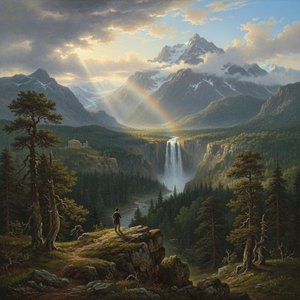
David Jandi: Bridging Impressionism and Hungarian Landscape
David Jandi (1893-1944) remains a relatively obscure figure in the annals of Hungarian art history, yet his canvases hold a remarkable beauty and capture a pivotal moment in artistic evolution – the confluence of Impressionist ideals with the burgeoning Hungarian landscape school. Born in Budapest, Hungary, Jandi’s formative years coincided with the rise of Symbolism and Art Nouveau, exposing him to stylistic explorations that would ultimately shape his distinctive oeuvre. However, it was his unwavering dedication to capturing the essence of Italian landscapes and Hungarian countryside that cemented his legacy as one of Hungary's foremost Impressionist painters.- Early Influences: Jandi’s artistic journey began amidst a vibrant cultural landscape dominated by Symbolism and Art Nouveau. Artists like Gustav Klimt and Edvard Munch profoundly impacted him, fostering an appreciation for expressive color palettes and evocative imagery—elements that would later permeate his own paintings.
- Formal Training & Parisian Exposure: Recognizing the importance of honing artistic skills, Jandi pursued formal training at the Budapest Academy of Fine Arts. Crucially, he spent several formative years in Paris during the Belle Époque, immersing himself in the epicenter of Impressionist innovation and engaging with artists like Claude Monet and Camille Pissarro. This Parisian experience instilled within him a deep understanding of plein air painting techniques and encouraged experimentation with light and color.
The Hungarian Landscape School & Jandi’s Vision
Jandi's artistic sensibilities were decisively molded by the burgeoning Hungarian landscape school, spearheaded by József Szilágyi. This movement championed a return to tonal painting—a reaction against the shimmering brilliance of Impressionism—emphasizing atmospheric perspective and capturing the subtle nuances of Hungarian landscapes. Despite this influence, Jandi skillfully blended tonal considerations with Impressionistic color harmonies, resulting in paintings that possessed both depth and luminosity. He sought to convey not merely what he saw but also how he *felt* about the natural world – a characteristic deeply rooted in the Romantic tradition.- Notable Subjects: Jandi’s artistic output focused primarily on Hungarian landscapes, particularly those surrounding Nagybánya (Bathory), where he established his studio. He depicted serene lakeshores, rolling hills dotted with wildflowers, and dramatic mountain vistas—subjects rendered with meticulous detail and infused with a palpable sense of tranquility.
- Technique & Style: Jandi’s technique involved layering thin glazes of color onto toned canvases, creating surfaces that shimmered with reflected light. His brushstrokes were loose yet controlled, conveying movement and texture without sacrificing compositional clarity. He skillfully employed atmospheric perspective to heighten the illusion of depth, mirroring the stylistic innovations championed by Szilágyi.
Major Achievements & Artistic Legacy
Jandi’s paintings gained recognition within Hungary's artistic circles during his lifetime and continue to be admired for their understated beauty and masterful execution. His works are housed in several Hungarian museums, including the Széchényi National Museum and the Hungarian National Gallery, ensuring that his vision of Hungarian landscape painting endures. Although overshadowed by more celebrated contemporaries, Jandi’s contribution to Hungarian art history is undeniable—he represents a crucial bridge between Impressionism and tonal painting, embodying the spirit of artistic exploration during Hungary's Belle Époque.Historical Significance
David Jandi’s oeuvre stands as a testament to the enduring power of artistic inspiration and the transformative influence of cultural exchange. His embrace of Impressionist principles alongside Hungarian landscape traditions reflects a broader trend toward reconciling European avant-garde movements with national artistic identities. By capturing the sublime beauty of Hungary's natural world, Jandi solidified his place in Hungarian art history as an artist who championed both innovation and authenticity—a legacy that continues to resonate today.Q&A
David Jandi의 작품 중 몇 점을 둘러보실 수 있나요?
전체 작품 보기 페이지에서 David Jandi의 작품 작품 33점점을 만나보실 수 있습니다.
주제별로 David Jandi의 작품을 찾아볼 수 있나요?
David Jandi의 작품은 작가의 주제별 작품 모음 페이지에서 주제별로 찾아보실 수 있습니다.
David Jandi의 작품을 연도순으로 어디에서 볼 수 있나요?
David Jandi의 작품은 작품 연대기 페이지에서 연도순으로 확인하실 수 있습니다.