The Dawn of a Belgian Visionary
Born in the heart of Brussels in 1796, Jean Baptiste Madou emerged as a vital voice in the rich tapestry of nineteenth-century Belgian art. His artistic journey began within the hallowed halls of the prestigious Brussels Academy of Fine Arts, where he studied under the disciplined guidance of Pierre Joseph Célestin François. While his early training was steeped in the formal traditions of Neoclassicism, Madou possessed a restless, observant spirit that sought something far more profound than idealized mythologies or grand historical narratives. He found his true calling not in the distant legends of antiquity, but in the breathing, bustling realities of the world around him, paving the way for a career defined by an unwavering commitment to the beauty of the everyday.From Lithographic Precision to National Chronicles
In the early decades of the nineteenth century, Madou harnessed the burgeoning power of lithography to document the very soul of his homeland. His tenure as a draftsman for the topographical military division at Kortrijk provided him with a unique and intimate vantage point, allowing him to traverse the Belgian landscape with a keen, almost scientific eye. This period was marked by an extraordinary technical evolution, as he translated the textures of rural life and the intricate customs of society into exquisite prints. Through collaborative projects such as Les vues pittoresques de la Belgique, Madou became more than just an artist; he became a visual historian, capturing the essence of Belgian heritage through a medium that could reach the hands of the many, documenting landscapes and societal nuances with unparalleled accuracy.The Parisian Transition and the Art of the Genre
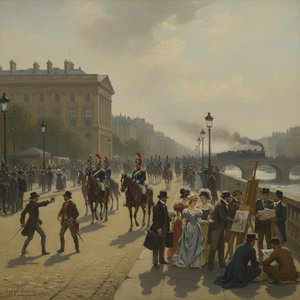
As the mid-century approached, Madou’s artistic ambitions underwent a transformative shift that would redefine his legacy. Around 1840, he transitioned from the graphic precision of lithography to the rich, emotive depths of oil painting, establishing himself within the vibrant and competitive artistic circles of Paris. This move propelled him into the vanguard of Belgian Realism, where he could explore the interplay of light and shadow in much more intimate, human settings. His works from this era, such as his evocative Study (1s45), transport viewers into the heart of communal life—crowded taverns, lively interiors, and the simple, shared pleasures of the working class.- Mastery of Composition: He utilized dense, layered figures to create a profound sense of movement and spatial depth.
- Theatrical Realism: His scenes were imbued with a dramatic light that suggested unfolding narratives and hidden stories.
- Observational Depth: Every detail, from the placement of a child on a floor to the warm glow of a candle, served to ground his work in a palpable reality.
A Lasting Legacy of Everyday Splendor
The true significance of Jean Baptiste Madou lies in his ability to elevate the mundane to the level of high art. By eschewing the grandiosity of traditional historical painting for the authentic, rhythmic pulse of village and city life, he resonated deeply with the sensibilities of a changing era. His legacy is etched into the very geography of Brussels, where the Madou metro station stands as a permanent tribute to his enduring influence. Through his meticulous observation and technical versatility, Madou ensured that the fleeting, vibrant moments of nineteenth-century Belgian life would be preserved forever in a glow of painterly brilliance.질의응답
Jean Baptiste Madou 작가는 어떤 색상을 가장 자주 사용했나요?
본 웹사이트에 등록된 작품 전반에 나타나는 Jean Baptiste Madou의 색채 활용은 작가의 팔레트 지놈 페이지에서 확인하실 수 있습니다.
Jean Baptiste Madou의 모든 작품을 어디에서 볼 수 있나요?
본 웹사이트에 등록된 Jean Baptiste Madou의 모든 작품은 작가의 모든 작품 보기 페이지에서 확인하실 수 있습니다.
Jean Baptiste Madou의 작품을 기법별로 모아볼 수 있는 곳은 어디인가요?
Jean Baptiste Madou의 작품은 작가 페이지인 모든 매체에서 매체별로 둘러보실 수 있습니다.