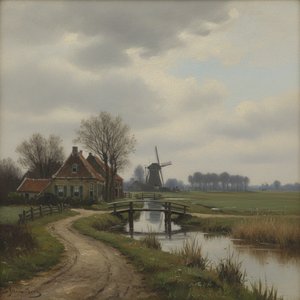
The Poet of Light: The Luminous World of Willem Maris
To step into a landscape painted by Willem Maris is to enter a world where the air itself possesses weight, moisture, and a profound sense of quietude. Born in The Hague on February 18, 1844, Maris would eventually become a cornerstone of the Hague School, a movement that championed luminous landscapes and imbued them with an unparalleled sensitivity to atmospheric conditions. While many of his contemporaries sought to document the rigid details of the Dutch countryside, Maris pursued something far more ephemeral. He famously proclaimed his artistic motto: “I don’t paint cows, but rather effects of light.” This singular philosophy transformed the humble subjects of his canvases—grazing cattle, damp meadows, and weeping willows—into vessels for a divine, shimmering radiance.
Maris's connection to the natural world was not merely academic; it was deeply personal and rooted in his earliest memories. Long before he mastered the brush, he spent countless hours observing the rhythms of the meadow, sitting among the livestock both before and after his school lessons. This intimate familiarity with animal behavior and anatomy provided him with an instinctive foundation that would later define his work. His artistic journey was further enriched by a familial tradition of creativity, as his brothers, Jacob and Matthaijs Maris, were also accomplished painters. This shared passion for the landscape fostered an environment of exploration and mutual guidance that helped shape the very essence of the Hague School's aesthetic.
From Meticulous Observation to Impressionistic Brilliance
The evolution of Maris’s technique reflects a profound maturation of vision, moving from the literal to the lyrical. In the early stages of his career, his work was characterized by a disciplined focus on precise reproductions of his surroundings. During this period, he applied his academic training from the Hague Academy of Art to study animal anatomy with painstaking detail, ensuring that every curve and muscle of his subjects was rendered with accuracy. This era of meticulous realism was significantly influenced by his mentorship under the cattle painter Pieter Stortenbeker, who provided Maris with essential commissions that allowed him to practice his craft outdoors, refining his ability to capture the raw reality of the Dutch polders.
As his mastery over the medium grew, Maris began to transcend mere representation. He moved away from the rigid traditions of his predecessors, embracing bolder color palettes and employing subtle gradations to convey the shifting nuances of light—a transition that aligned him with the burgeoning spirit of Impressionism. By around 1880, his style underwent a final, breathtaking transformation. His brushwork became looser and more expressive, utilizing impasto to create canvases brimming with texture. In these later works, the boundary between earth and sky often dissolves into a seamless, silvery haze, where the light does not simply fall upon the landscape but seems to emanate from within it.
A Lasting Legacy of Atmospheric Realism
The historical significance of Willem Maris lies in his ability to find the sublime within the ordinary. He was a master of what is often described as "grey light"—that nuanced, monochromatic spectrum of silver, pearl, and slate that defines the Dutch atmosphere. Through his work, the damp, misty reaches of the Netherlands were elevated to a level of poetic grandeur. His paintings do not merely document scenery; they translate the very breath of the Low Countries onto canvas, capturing the way light filters through heavy Atlantic cloud cover to illuminate a wet meadow or a quiet canal.
Ultimately, Maris’s contribution to art history is measured by his ability to evoke emotion through atmosphere. His legacy remains etched in the way we perceive the beauty of the overcast sky and the tranquil dignity of rural life. Through his eyes, we see that:
- The subject is secondary to the sensation: The cows and willows serve as anchors for the true protagonist—the light itself.
- Texture conveys truth: His use of thick, tactile paint brings a physical presence to the moisture and mist of the Dutch landscape.
- Nature is a living entity: His work captures the rhythmic, breathing quality of the countryside, making the landscape feel eternally alive.