Peržiūrėti realybėje
 Pasidalinti
 Dalintis
 Išsamiau

 Atsisiųsti
 Panašūs eksponatai
 Rentgeno nuotrauka
 Automatinė diorama
Margarita įščiūpusi į angelus ir šventuosius


 Skaityti daugiau
Rankų darbo aliejinės reprodukcijos
Rankiniu būdu tapytas aliejus ant droblio jūsų pageidaujamame dydį ir rėmuose – mūsų menininkų darbas pagal užsakymą. ( Perejti prie spausdinimo Perjungti į vaizdą)




P118B $10

P118H $10

P118W $10

P438Z $10

P508JH $12

P508YH $12

P805H $10

P805Z $10

P919BZ $10

P919G $10

P919XJ $10

P959ZH $10

P968JZ $12

W106C $8

W218G $10

W218JH $8

W218Y $10

W307PJ $10

W316G $10

W316PJ $8

W316Y $10

W398PJ $8

W4111J $10

W500HY $15

W500JH $15

W692G $12

W849H $8

W940BG $15

W953PJ $8




Pasirinkite iš mūsų nustatytų dydžių, atitinkančių originalaus meno kūrinio proporcijas.

Galite įvesti savo matmenis, kad jie atitiktų konkretų rėmą ar erdvę. Jei pasirinktas dydis neatitinka originalaus paveikslėlio proporcijų, mes arba apkropsime meno kūrinį, arba papildysime tapybą rankomis dažytい elementais. Prieš pradėdami gamybą, jūsų patvirtinimui atsiųsime skaitmeninį maketą.
Atkreipkite dėmesį, kad ekrane rodomas vaizdas neatspindi tikrojo apkarpymo ar papildymo. Tik maketas tiksliai parodys galutinę kompoziciją.
Nors galima rinktis ir individualius dydžius, rekomenduojame pasirinkti matmenis iš nustatytos sąrašo, kad būtų išlaikytos originalios proporcijos.
Gavus užsakymą, AllPaintingsStore.com komanda susisieks su klientu el. paštu dėl instrukcijų ir pateiks maketo pavyzdį.
Pristatymas visame pasaulyje () per 3–4 savaites, o ne įprastai – per 5 savaites. (10 rugpjūtis). Kokybė lieka nepakeičiama.

Nemokamas greitasis pristatymas visame pasaulyje

Aukštos kokybės lininis drobė

Pilnas siuntimo draudimas

Muitinės mokesčių grąžinimo garantija

Tikro spalvų atitikimo garantija

60 dienų grąžinimo politika (tik esant gamyklinėms defektams)

100% pinigų grąžinimo garantija

Nuolaida už kelias reprodukcijas
 Stiklo variantas prieinamas tik pasirinkus dydį iki 110 cm

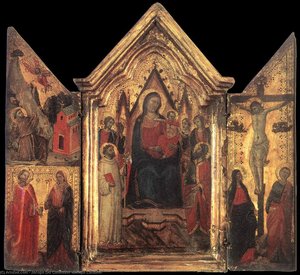
Margarita įščiūpusi į angelus ir šventuosius
Reprodukcijos technika
Reprodukcijos matmenys
-


Galutinė kaina
$ 258
Kūrinio aprašymas
Šventosios Marijos Karūniją Švelniu Šviesos Švietimu
Štai vienas iš Florences žymiausių meno kūrinių – šventosios Marijos karūnija švelniu švietumu dekoruota freska, kurią sukūrė italijos dailininkas Jacopo del Casentino (Jacopo Landino) apie 1320 metus. Šis paveikslas yra įvykis religijai ir meno istorijoje – jis išraiškina Florences tikrąją šventumo dvėsenę bei puikiai demonstruoja chiaroscuro techniką, kuri išgarsėjo Renesanso dailėje. Štai kaip šį meistriškumą galima aprašyti.- Šūkis ir Tema: Freska užfiksuoja įvykį religijoje – Šventosios Marijos karūniją, kurią aplanko angelai ir šventieji. Tai nėra tik dekoratyvus paveikslas; jis yra simbolinis veiksnys Florences visuomenės kultūroje ir tikėjime.
- Švietimo Technika: Jacopo del Casentino išgarsėjo dėl savo naudojamos chiaroscuro technikos – švelnios šviesos ir šešėlių žaidinėjimo. Šis metodas buvo itin svarbus Renesanso dailininkams, leidžiant švelnią švietimą įspūdingai išraiškoti ir suteikti paveiksleui emocinį poveikį.
- Istoriniai Kontextas: Štai kaip šiuo laikotarpiumi domėjosi Italija – Renesansas buvo laikomas aukščiausiu kultūros gyvenimu. Jacopo del Casentino veikė šio periodo pradžioje, kai Florences dailininkai ieškojo naujų būdų išraiškoti savo tikėjimą ir įvairovę.
- Simbolizmas: Freskoje naudojami simboliai yra labai svarbūs. Šventosios Marijos karūnija švelniu švietumu dekoruota freska simbolizuojasi Šventųjų Moters Šventumu ir Šventųjų Švietimu, kuriuos įvykę dailininkai puikiai išraiškino savo kūriniuose.
- Emocinis Poveikis: Žiūrėtojui šis paveikslas suteikia emocinį poveikį – jis kviečia įsiminti Šventosios Marijos karūniją švelniu švietumu dekoruotą freską kaip vieną iš Florences kultūros pavyzdžių.
panašūs kūriniai


Autoriaus biografija
The Ethereal Legacy of Jacopo del Casentino
In the vibrant, sun-drenched landscape of fourteenth-century Tuscany, a period defined by profound spiritual devotion and the dawn of artistic transformation, the name Jacopo del Casentino resonates with the quiet power of a prayer. Often known to history through the mistaken identity of Jacopo Landino—a nomenclature born from the historical errors of Giorgio Vasari—this Florentine master navigated the delicate transition between the late Gothic tradition and the burgeoning sensibilities of the early Renaissance. While the precise details of his birth and early years remain shrouded in the mists of time, his presence is indelibly etched into the sacred altarpieces that once graced the chapels of Italy, serving as a bridge between the stylized elegance of the past and the humanistic depth of the future.
The origins of his artistry are deeply rooted in the Florentine milieu, likely shaped by the influential circle surrounding the Master of St. Cecilia. This formative period instilled in him a reverence for sacred geometry and a capacity to translate theological complexity into visual splendor. His work does not merely depict religious scenes; it invites the viewer into a state of contemplation. Through his brush, the divine becomes tangible, as he mastered the subtle art of chiaroscuro long before it became a hallmark of the High Renaissance. By manipulating the interplay of light and shadow, he breathed life into drapery and gave weight to the celestial figures that populate his compositions, creating a sense of three-dimensional presence that was revolutionary for his era.
Mastery of Light and Devotional Grandeur
The true brilliance of Jacopo del Casentino is most vibrantly realized in his monumental depictions of the Virgin Mary. His Madonna Enthroned with Angels and Saints stands as a testament to his ability to command both scale and emotion. In this masterpiece, one can witness the artist's profound skill in rendering the ethereal glow that surrounds the Queen of Heaven. The throne, adorned with rich, heavy fabrics, serves as an anchor for the composition, while the surrounding angelic figures radiate a serene luminescence that seems to emanate from within the painting itself. This careful orchestration of light does more than illuminate; it sanctifies the space, guiding the eye toward the central mystery of the Incarnation.
Beyond his celebrated Madonnas, Jacopo’s repertoire included significant works such as the Crucifixion and various Madonna and Child compositions, each demonstrating a versatile command over different narrative tones. In his more somber works, he utilized shadow to evoke the profound sorrow of the Passion, whereas in his devotional icons, he employed a luminous palette to inspire hope and reverence. His ability to weave complex theological narratives into a single, cohesive visual experience allowed him to communicate with both the literate clergy and the faithful laity, making his art a vital instrument of the Church's spiritual mission.
Historical Significance and Artistic Impact
Though the historical record regarding his exact lifespan is subject to scholarly debate—with some placing his activity in the first half of the 14th century—his impact on the Florentine school remains undeniable. He was a painter who understood that art was not merely an ornament but a window into the divine. His contributions helped lay the groundwork for the next generation of masters, providing a foundation of technical precision and emotional sincerity upon which the giants of the Renaissance would later build.
To study the works of Jacopo del Casentino is to witness the evolution of the human spirit through paint. His legacy survives in the enduring beauty of his altarpieces, which continue to captivate modern observers with their:
- Spiritual Depth: A profound ability to evoke religious ecstasy and quiet piety.
- Technical Innovation: Early mastery of light, shadow, and the illusion of volume.
- Iconographic Clarity: The seamless integration of complex Christian symbolism within accessible, beautiful compositions.

jacopo del casentino (jacopo landino)
1330 - 1380 , Italy
Trumpa informacija
- Artistic Movement Or Style: Renaissance
- Date Of Birth: Florence, Italy (1330)
- Date Of Death: 1380
- Full Name: Jacopo del Casentino (jacopo landino)
- Nationality: Italian
- Notable Artworks:
- Madonna Enthroned with Angels and Saints
- Madonna and Child
- Crucifixion
- Place Of Birth: Florence
Susiję straipsniai
Uffizi Galerijos Šedevrai: 25 Renesanso Perlai Jūsų Interjerui
Atraskite 25 įspūdingiausius Uffizi galerijos šedevrus Florencijoje! Leonardo da Vinci, Botticelli ir Mikelandželo kūriniai – meno istorija jūsų namams. Kokybiškos reprodukcijos ir interjero dekoravimo idėjos AllPaintingsStore.com.

Divine Grace: A Journey Through the Most Iconic Depictions of the Virgin Mary in Art History
Embark on a profound journey through art history with our exploration of the most iconic depictions of the Virgin Mary. Discover the divine grace, symbolism, and masterful techniques found in Renaissance masterpieces and sacred iconography.

Fra Angelico Šedevrai: Top 25 Kūrinių Elegancija Jūsų Interjere
Atraskite 25 įspūdingiausius Fra Angelico šedevrus! Renesanso meno grožis, religinė tapyba ir angelų paveikslai. Meno istorija, interjero dizaino idėjos bei aukštos kokybės reprodukcijos AllPaintingsStore.com. Explore the full collection online!
Rafaelio Šedevrai: Top 25 Tapybų Kūriniai Jūsų Interjerui | AllPaintingsStore
Atraskite 25 įspūdingiausius Rafaelio paveikslus! Išsami istorija, technikos ir meno stiliai. Renesanso tapybos šedevrai jūsų interjerui – aukštos kokybės reprodukcijos AllPaintingsStore.com. Explore the full collection online!

Divine Grace: An Art Historian's Journey Through Iconic Masterpieces of the Virgin Mary
Explore the profound beauty of Marian iconography through an art historian's lens. Discover iconic masterpieces by Raphael and Renaissance masters, celebrating the divine grace and timeless elegance of the Virgin Mary in classical fine art.