Giovanni Battista Piranesi (1720–1778): Italian Master of Etching
Giovanni Battista Piranesi, born in Mogliano Veneto in 1720, was an artist who didn’t simply depict the world around him; he reimagined it, conjuring spaces that resonated with both historical grandeur and a profound psychological weight. His life unfolded during a period of fervent archaeological rediscovery, as Rome shed layers of time, revealing its ancient heart to eager scholars and artists. But Piranesi wasn't content with mere documentation. He transformed the ruins into something more—evocative landscapes of the imagination, imbued with an atmosphere of mystery and awe. The son of a stonemason, he possessed an innate understanding of architectural form and material, a sensibility nurtured by early exposure to the physicality of building. This foundation was further strengthened through instruction from his uncle, Matteo Lucchesi, an architect, and later, rigorous training in engraving under Giuseppe Vasi, a leading Roman printmaker. This unique blend of design expertise and technical skill allowed Piranesi to seamlessly merge architectural precision with dramatic artistic vision.
Early Life and Training
Piranesi’s upbringing instilled in him a deep appreciation for craftsmanship and the beauty of natural stone—skills that would prove invaluable throughout his artistic career. His father, a stonemason, taught him practical techniques for shaping and manipulating materials, while Matteo Lucchesi imparted knowledge of architectural design principles. Recognizing Piranesi's talent, Lucchesi encouraged him to pursue studies in Rome, where he encountered the burgeoning intellectual fervor of the Enlightenment.
The Influence of Giuseppe Vasi
Crucially, Piranesi’s artistic development was shaped by his apprenticeship with Giuseppe Vasi, a celebrated Roman printmaker. Vasi recognized Piranesi's exceptional aptitude for engraving and mentored him in mastering the art form—a skill that would become synonymous with Piranesi’s distinctive style. Under Vasi’s guidance, Piranesi honed his etching technique, experimenting with innovative approaches to tonal gradation and perspective.
Rome: The Cradle of Inspiration
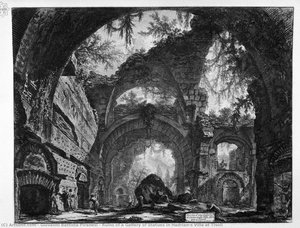
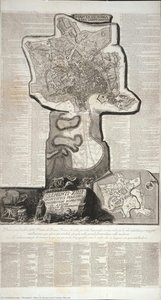
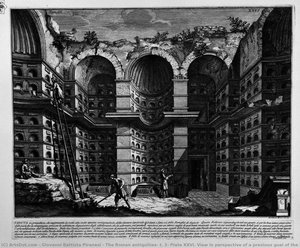
Piranesi's fascination with Rome began early in life and intensified during his extended travels throughout Italy. He was particularly captivated by the city’s ancient monuments—the Colosseum, the Pantheon, the Forum—and he meticulously documented their grandeur through a series of etchings that would become legendary. These prints weren’t merely reproductions; they were interpretations—visions of Rome as it *could* be perceived—infused with Piranesi's own imaginative sensibility.
The Carceri d'Invenzione: Fantastical Prisons
Piranesi is arguably most celebrated for his series of etchings known as the Carceri d’Invenzione (Imaginary Prisons), created between 1745 and 1761. These aren’t representations of actual prisons, but rather fantastical labyrinths—colossal staircases spiraling into darkness, towering arches framing endless vistas, shadowy vaults echoing with unseen presences. The scale is deliberately disorienting; human figures are dwarfed by the immense architecture, emphasizing a sense of isolation and powerlessness. Piranesi’s use of perspective and chiaroscuro—the dramatic contrast between light and shadow—creates an unsettling atmosphere that reflects his preoccupation with psychological themes.
Vedute di Roma: Reconstructing Roman Grandeur
Alongside his fantastical creations, Piranesi produced a vast body of work documenting the real architecture of Rome—known as Vedute (Views). However, these weren’t straightforward topographical representations. They were carefully composed scenes that emphasized the monumentality and historical significance of ancient ruins. He meticulously researched and depicted Roman landmarks like the Forum, the Colosseum, and the Pantheon, often incorporating figures to provide a sense of scale and animation. Piranesi's approach to etching—his willingness to reconstruct damaged structures based on his understanding of ancient building techniques—established him as a pioneer in architectural illustration and profoundly influenced subsequent generations of artists.
Legacy and Influence
Giovanni Battista Piranesi’s work continues to inspire awe and admiration for its originality, technical virtuosity, and psychological depth. His etchings—particularly the Carceri—have been interpreted as allegories for oppression, reflections of Enlightenment anxieties, and explorations of the human subconscious. Piranesi's influence can be seen in the art of Romantic painters like Turner and Doré, as well as in contemporary filmmakers and architects who strive to capture the grandeur and mystery of ancient spaces.
Klausimai ir atsakymai
Kur galima rasti Džovanis Batista Piranezis kūrybą, sugrupuotą pagal spalvas?
Džovanis Batista Piranezis kūrybą pagal spalvas galite tyrinėti puslapio Spalvų indeksas svetainėje.
Kur galima rasti sugrupuotą pagal spalvų paletę Džovanis Batista Piranezis kūrybą?
Pagrinti pagal spalvų paletę puslapio darbai Džovanis Batista Piranezis kūryboje suskirstyti pagal jų spalvų paletę.
Kur ir kada gimė Džovanis Batista Piranezis?
Džovanis Batista Piranezis gimė Moljano Veneto, 1720 m.