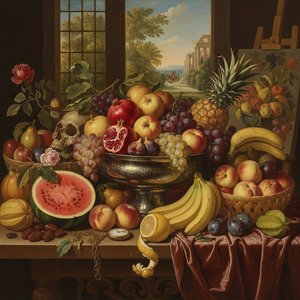
Jacob Marrel: Life and Legacy
Early Life and Training
- Born: Frankenthal, Germany in 1614.
- In 1624, Marrel moved with his family to Frankfurt.
- He began his artistic training in 1627 as a student of Georg Flegel, a prominent still life painter specializing in pantry and flower pieces.
- This early exposure laid the foundation for Marrel’s future specialization.
Utrecht and the Influence of Jan Davidszoon de Heem
- Attracted by the lucrative market for flower still lifes, Marrel traveled to Utrecht between 1632 and 1650.
- He studied extensively under Jan Davidszoon de Heem, a master of opulent and detailed still life compositions.
- De Heem’s influence is evident in Marrel's later works, particularly his use of rich colors, dramatic lighting, and complex arrangements.
- This period was crucial for Marrel’s artistic development, refining his technique and establishing his style.
Return to Frankfurt and Family Connections
- Around 1650, Marrel returned to Frankfurt and married Johanna Sybilla Heim(ius), the widow of Matthäus Merian.
- He took on students, fostering a workshop environment.
- A significant connection: His step-daughter, Maria Sibylla Merian, became a renowned painter and naturalist specializing in insects and flowers – rivaling Rachel Ruysch in fame.
- Merian later married one of Marrel’s pupils, Johann Andreas Graff, further solidifying the artistic lineage.
Artistic Style and Major Works
- Specialization: Marrel is celebrated for his exquisite flower still lifes, often featuring meticulously rendered blooms, including tulips which he frequently depicted as individual 'portraits'.
- His compositions are characterized by a sense of abundance and luxury.
- He skillfully balanced realism with artistic arrangement, creating visually stunning and harmonious works.
- Notable Works: Include “Still-Life with Flowers”, “Flowers, parrot and tit”, and “Quiet Life With Roman, Silver Tazza, Fruits, Pastries And Bird”.
Later Years and Legacy
- Marrel revisited Utrecht in 1660 with his student Abraham Mignon.
- He established a flower painting school in Frankfurt after returning to Germany in 1665.
- He remained active as an art dealer in Utrecht until 1669.
- Death: Jacob Marrel died in Frankfurt in 1681.
- Historical Significance: He played a vital role in popularizing flower still life painting during the Dutch Golden Age and influenced subsequent generations of artists, most notably his step-daughter Maria Sibylla Merian.
Klausimai ir atsakymai
Iš kokios šalies yra Jacob Marrel?
Jacob Marrel gimė Germany.
Kur galiu pamatyti Jacob Marrel kūrybinę veiklą chronologine tvarka?
Jacob Marrel kūrybos laiko linija Kūrybos chronologija pateikia Jacob Marrel darbus chronologine tvarka, metus po metų.
Kur ir kada gimė Jacob Marrel?
Jacob Marrel gimė Frankenthal, 1614 m.
Ar galima rasti Jacob Marrel kūrybos darbų pagal spalvą?
Puslapio Spalvų indeksas kūriniai Jacob Marrel sugrupuoti pagal spalvą.