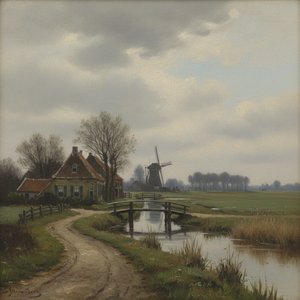
The Quiet Observer of Twente
Born in Elsenerbroek, Jan Broeze lived a life deeply rooted in the landscape of the Hof van Twente. His hands were rarely still, moving between the heavy application of oil paint on canvas and the delicate precision of a pen drawing. He was a man of many tools, working with charcoal, chalk, and sepia to capture the world around him. His origins were humble, coming from a farming background, and this connection to the earth seems to settle into the very texture of his work. He did not merely look at a scene; he sat with it, whether it was a village view or a simple house with a barn.
His studio, located in the hamlet of Elsenerbroek, remains a place of memory. It is a space where the tools of his trade—brushes, palettes, and various tubes of paint—once sat in constant use. The work he produced was not limited to a single medium. He moved through different ways of seeing, sometimes using the structured approach of pointillism to build a view of Markelo or Zutphen, and at other times leaning into the abstraction of a cubist village or city. His output was varied, reflecting a restless curiosity about how light and form settle upon a landscape.
A Hand for Every Medium
The breadth of his technical skill allowed him to approach the same subject through many different lenses. A single view might be rendered in the soft, fading tones of sepia or the sharp, permanent lines of East Indian ink. His collection of works shows a preference for the specificities of his surroundings, often focusing on the architecture of small towns and the quietude of rural life.
- Oil paint on canvas and panel for larger, more permanent compositions.
- Watercolor and gouache for capturing the lightness of a moment.
- Pencil, charcoal, and Conté for the study of shadow and line.
- Mixed media and pointillism for exploring texture and light.
His subjects were often the places he knew best. He painted the streets of Bronckhorst and the views of Zutphen, capturing the way a church sits within a village or how a road leads toward a distant hamlet. Even when his style shifted toward the cubist, the essence of the place remained. He was as comfortable with the heavy weight of oil as he was with the light touch of a watercolor brush.
The Marks Left Behind
The legacy of his work is held in collections like the Rijksmuseum Twenthe, where his depictions of local life are preserved. His paintings often reflect the atmosphere of the years following the war, capturing a sense of place during a period of transition. Whether it was a commissioned piece for a local church or a small study of a house in Silezie, his work remains a record of the visual world as he encountered it. He died in Delden, leaving behind a body of work that spans from the early decades of the twentieth century through the late sixties, a quiet chronicle of the landscapes and structures that define his home.
Klausimai ir atsakymai
Ar yra Jan Broeze kūrybos istorijos chronologija?
Jan Broeze Karieros istorija – tai vartojimo metu judanti laiko linija, kurioje kūrybos darbai pateikiami chronologine tvarka, suskirstyti į karjeros periodų skyrius.
Kaip rasti Jan Broeze darbus konkrečia tema?
Jan Broeze kūrybą galima tyrinėti pagal raktažodžius tame šio autoriaus Raktažodžiais puslapyje. Kiekvienas raktažodis sugrupuoja susijusią kūrybinę veiklą.
Ar galiu apsilankyti virtualiame Jan Broeze kūrybos muziejuje?
Jan Broeze 3D galerija yra puslapis, kuriame kūriniai rodomi virtualioje trimensione galerijoje.
Kur galima rasti sugrupuotą pagal spalvų paletę Jan Broeze kūrybą?
Pagrinti pagal spalvų paletę puslapio darbai Jan Broeze kūryboje suskirstyti pagal jų spalvų paletę.