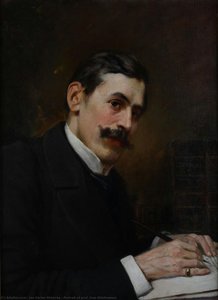
The Bohemian Roots of a Bulgarian Master
Born Jan Václav Mrkvička in the quiet village of Vidím nad Mělníkem, the man who would become a cornerstone of Bulgarian art began his journey far from the Balkan landscapes he would eventually immortalize. His early years were defined by the rigorous academic traditions of Central Europe, as he sought refinement within the prestigious Academy of Fine Arts in Prague under the guidance of Antonin Lhota. This foundation of Czech Romanticism was later enriched by the vibrant, light-filled techniques encountered at the Munich Academy of Arts. It was this unique synthesis—a marriage of disciplined academic precision and a burgeoning Impressionist sensibility—that prepared him for his transformative move to Plovdiv in 1881.
As he transitioned from a student of the Czech lands to a resident of the Bulgarian territories, his artistic identity began to merge with the spirit of his new home. He did not merely observe a new culture; he became its visual biographer, absorbing the rhythms and textures of a nation finding its footing following centuries of Ottoman rule.
Capturing the Soul of a Nation
Mrkvička’s brush possessed a rare ability to capture the raw, unvarnished beauty of a people reclaiming their identity. He turned his gaze toward the rhythmic pulse of the marketplace and the intimate rituals of rural life, creating a visual language for a new era. His works often focused on the intersection of human struggle and cultural celebration, bringing the vibrant colors of Bulgarian folklore to the forefront of modern art. Through his meticulous attention to detail and masterful command of light, he documented:
- The bustling energy of the Plovdiv Marketplace, where commerce and community intersected in a vivid display of local life;
- The poignant dignity found in genre scenes such as Sakadzhii and Poultry Dealer, which elevated everyday labor to the level of high art;
- The ancestral echoes of folk traditions, most notably seen in his evocative depictions of Lazarus Saturday dancers.
His style, characterized by a lyrical observation of nature and people, allowed him to portray Bulgarian culture with an empathy that transcended mere documentation. He was able to weave the sunlight of the Balkan landscape into the very fabric of his compositions, making the ephemeral moments of village life feel eternal.
An Enduring Artistic Legacy
Beyond the canvas, Mrkvička’s influence was institutional and profound. He was not just a painter but an architect of Bulgaria's artistic future, co-founding the National Academy of Arts in Sofia in 1896 alongside luminaries like Konstantin Velichkov. Through his role as a professor and director, he nurtured the first generations of Bulgarian masters, ensuring that the flame of modern fine art would burn brightly long after his departure. His contribution even extended to the very symbols of the state, lending his artistic hand to the design of the Coat of Arms for both Sofia and the nation itself.
Even as he eventually returned to his Czech homeland toward the end of his life in 1938, his impact remained indelible. He left behind a legacy that remains inseparable from the Bulgarian national spirit—a testament to an artist who found his true calling in the light, the color, and the enduring heart of a distant, beautiful land.
Klausimai ir atsakymai
Kokias nuota išreiškia Jan Václav Mrkvička kūryba?
Jan Václav Mrkvička Nuotaudų kambarys – tai puslapis, kuriame kūriniai sugrupuoti pagal nuotaiką.
Kur ir kada gimė Jan Václav Mrkvička?
Jan Václav Mrkvička gimė Vidím nad Mělníkem, 1856 m.
Kuriame istoriniame laikotarpyje kūrė Jan Václav Mrkvička?
Jan Václav Mrkvička kūrė 19th Century laikotarpiu. Šis laikotarpis leidžia įvertinti kūrybinę veiklą istoriniame kontekste.