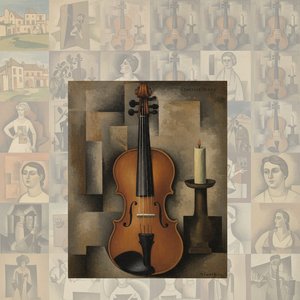
1906. Acrylic On Canvas.

§ 1Catalogue data


Dit kunstwerk is auteursrechtelijk beschermd
De kunstwerken die op deze pagina worden weergegeven, zijn beschermd door de auteursrechtwetgeving, wat betekent dat het ons wettelijk niet is toegestaan om identieke reproducties te maken of te verkopen. Deze bescherming wordt gehandhaafd onder internationale overeenkomsten zoals de Conventie van Bern en door nationale wetgeving, waaronder de bepalingen van de Amerikaanse auteurswet - Titel 17. Alle rechten voorbehouden. Reproduceren of distribueren van afbeeldingen is niet toegestaan zonder uitdrukkelijke schriftelijke toestemming van WahooArt.com en de rechthebbenden.
Als een respectvol en legaal alternatief bieden wij op maat gemaakte, handgeschilderde kunstwerken aan die geïnspireerd zijn op het origineel. Onze bekwame en professionele kunstenaars bestuderen zorgvuldig de stijl, sfeer en artistieke essentie van het origineel om een nieuw, uniek werk te creëren dat dezelfde emotie oproept – terwijl het een op zichzelf staande, originele creatie blijft.
Deze methode voldoet volledig aan de auteursrechtwetgeving, omdat het niet gaat om het kopiëren of dupliceren van het beschermde kunstwerk. In plaats daarvan is er sprake van een creatieve herinterpretatie — een nieuw schilderij dat door het origineel wordt geïnspireerd, maar er niet identiek aan is.
 Lees meer over
§ 2Abstract
Beschrijving verzamelobject
This artwork is considered a seminal piece in the development of Cubism, marking Braque’s significant contribution to modern art history.
Biografie kunstenaar
Georges Braque (1882-1963): Pionier van het kubisme & fauvisme. Ontdek zijn baanbrekende kunst, van 'Houses at L'Estaque' tot indrukwekkende collages. Een meester van de moderne kunst!
§ 3Commentary
Georges Braque’s Anatomical Exploration: “The Study of Nude”
Georges Braque's "The Study of Nude," created in 1906, stands as a cornerstone of early Cubism and exemplifies the artist’s groundbreaking approach to representing form and space. More than just a depiction of the human figure—a subject central to artistic tradition—this sketch delves into a profound investigation of perception itself, mirroring Braque's intellectual engagement with philosophical ideas surrounding simultaneity and fragmentation.- Subject Matter: The artwork centers on a nude female torso viewed from behind, subtly positioned within an intimate setting implied by two indistinct figures flanking her. This deliberate choice avoids idealized beauty, prioritizing anatomical accuracy and capturing the essence of human presence rather than presenting it as aesthetically pleasing.
- Style & Technique: Braque’s masterful use of charcoal or graphite—a technique favored for its ability to convey texture and tonal nuance—is paramount. The drawing employs hatching and cross-hatching extensively, creating a palpable sense of depth through layered shading that mimics the way light interacts with surfaces. These lines aren't merely delineating contours; they actively sculpt volume, mirroring Braque’s desire to break free from conventional perspective.
- Historical Context: Produced during the formative years of Cubism alongside Pablo Picasso, “The Study of Nude” reflects the burgeoning artistic movement’s rejection of illusionistic representation. Artists like Braque and Picasso wrestled with how to depict reality when viewed simultaneously from multiple viewpoints—a concept championed by philosophers like Henri Bergson—resulting in fractured planes and geometric shapes that challenge viewers' expectations.
- Symbolism & Emotional Impact: Beyond its technical prowess, the drawing resonates with a quiet contemplation. The woman’s posture conveys vulnerability and introspection, inviting viewers to consider themes of solitude and connection. The sketch’s immediacy speaks to the artist’s process—a spontaneous capture of form—and underscores Braque's commitment to exploring fundamental questions about visual perception.
- Detailed Analysis: Consider the deliberate flatness achieved through shading; it deliberately avoids creating a convincing illusion of depth, aligning with Cubist principles. The subtle interplay between hatching and crosshatching contributes significantly to the artwork’s textural quality, simulating the surface appearance of skin and fabric. Furthermore, observe how Braque utilizes simplified geometric forms in the background figures—a stylistic choice that reinforces the conceptual framework underpinning the piece.
Further Exploration & Reproduction Recommendations
For those captivated by Braque’s pioneering vision, AllPaintingsStore.com offers exceptional reproductions of “The Study of Nude,” meticulously crafted to preserve the artwork's original tonal palette and textural subtleties. Explore high-resolution prints on premium canvas or framed versions that elevate this seminal piece into a stunning centerpiece for any interior space—a testament to Braque’s enduring legacy in modern art history.Veelgestelde vragen
Waar kan ik de afbeelding van "The study of nude" door Georges Braque downloaden?
Er is een download beschikbaar voor "The study of nude": de Downloaden pagina van het kunstwerk biedt de mogelijkheid om een digitale afbeelding in hoge resolutie om te downloaden.
Is er een gids beschikbaar voor "The study of nude" door Georges Braque?
De Informatieblad-pagina van "The study of nude" door Georges Braque biedt een printbaar factsheet van twee pagina's: het kunstwerk met de bijbehorende identificatietabel, een tijdlijn die het werk plaatst binnen de levensloop van de kunstenaar, andere werken van de kunstenaar, het gemeten kleurenpalet en kant-en-klare citaten in vier verschillende stijlen.
Hoe verhoudt "The study of nude" zich tot het oeuvre van Georges Braque?
"The study of nude" deelt met andere werken van Georges Braque de Cubism-stijl en de terugkerende thema's: analytical cubism, braque’s experimentation, formal exploration, geometric abstraction, proto-cubist influence.


 Schakel over naar print


 Voor kunstwerken of reproducties die aan één zijde groter zijn dan 105 cm (ongeveer 41 inch), wordt de lijst als een losse set verzonden. Deze methode garandeert een veilige levering en voorkomt schade tijdens het transport.