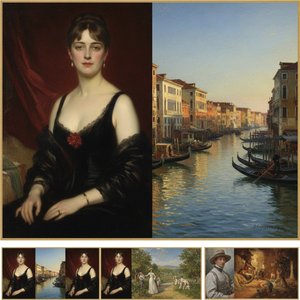
Edward Borein (1872-1945) wasn't merely a painter of the American West; he was its visual poet, a chronicler who captured not just *what* it looked like, but how it *felt*. Born in San Francisco to Lithuanian immigrant parents, Borein’s early life was steeped in the romance and rugged realities of California. His father, a lithographer, instilled in him a love for draftsmanship and printmaking – skills that would become foundational to his artistic expression. However, young Edward wasn't confined to the studio; he yearned for the open range, spending formative years on his uncle’s cattle ranch near Gilroy. This immersion into cowboy life, horsemanship, and the vast landscapes of the West ignited a lifelong passion that permeated every brushstroke and etching. He didn’t just observe the West, he *lived* it, working as a wrangler, packer, and even briefly attempting to become a professional bronc rider – experiences that lent an unparalleled authenticity to his art.
From Lithography to Watercolor: A Developing Style
Borein's artistic journey began with lithography, a medium he mastered early on. He worked for various commercial printing houses in San Francisco, creating illustrations for advertisements and periodicals. But the limitations of commercial work soon chafed against his desire to depict the West as he saw it – wild, untamed, and imbued with a sense of freedom. Around 1900, Borein began transitioning towards watercolor, a medium that allowed him greater flexibility and nuance in capturing the subtle shifts of light and atmosphere. This shift wasn’t abrupt; his lithographic training informed his watercolor technique, resulting in a distinctive style characterized by crisp lines, meticulous detail, and a remarkable sense of movement. He favored muted earth tones – ochres, browns, grays – that evoked the dusty plains, sun-baked canyons, and weathered faces of the West. While he admired artists like Charles Russell and Frederic Remington, Borein forged his own path, focusing less on dramatic action and more on capturing the quiet moments of everyday life on the range: cowboys tending cattle, horses grazing in a meadow, Native Americans engaged in traditional ceremonies.
Themes and Symbolism in Borein’s Work
Borein's art is deeply rooted in the history and culture of the American West, particularly the lives of vaqueros, cowboys, and Native Americans. He developed a profound respect for the traditions and skills of the Spanish-Californian rancheros, often depicting them with dignity and reverence. His paintings are filled with subtle symbolism that reflects his understanding of Western lore and mythology. The horse, naturally, is a recurring motif – not merely as a mode of transportation but as a symbol of freedom, power, and resilience. His depictions of Native Americans, while sometimes romanticized by the standards of today, were groundbreaking for their time; he sought to portray them as individuals with complex lives and rich cultural heritage, rather than as stereotypical “savages.” He frequently included scenes of roundups, branding, and other ranch activities, not just as representations of work but as celebrations of a vanishing way of life. The sense of melancholy that pervades much of his work speaks to the inevitable clash between cultures and the loss of the open frontier.
Major Achievements and Lasting Legacy
Throughout his career, Borein exhibited widely, gaining recognition for his evocative watercolors and etchings. He was a founding member of the California Art Club and actively promoted Western art through exhibitions and publications. He illustrated several books on the West, including “The Life and Adventures of Nat Love,” a biography of an African-American cowboy, demonstrating his commitment to representing diverse voices within the Western narrative.
Borein’s work was instrumental in shaping the public perception of the American West.
His paintings helped to preserve the memory of a vanishing way of life.
He bridged the gap between historical documentation and artistic interpretation.
Although he never achieved the same level of commercial success as some of his contemporaries, Borein’s art has experienced a resurgence in recent years. His paintings are now highly sought after by collectors and museums, and his work continues to inspire artists and enthusiasts alike. He left behind a rich body of work that serves as a testament to his skill, vision, and deep love for the American West – a legacy that ensures his place among the most important chroniclers of this iconic landscape and its people.
Explore the evolution of Richard Diebenkorn's iconic art – from abstract expressionism to his celebrated Ocean Park series. Discover insights for collectors & enthusiasts.
Ontdek de 25 mooiste meesterwerken van John Singer Sargent! Van elegante portretten tot impressionistische schilderijen – leer over zijn leven, techniek & impact. Museumkwaliteit reproducties voor uw interieur op AllPaintingsStore.com.
Wat is het best beoordeelde schilderij van Edward Borein op ArtsDot.com?
Cowboy Hazing a Steer
Onder welke andere namen staat Edward Borein bekend?
John Edward Borein
Waar komt Edward Borein vandaan?
United States
Wanneer is Edward Borein overleden?
1945
Wat zijn de 3 best beoordeelde schilderijen van Edward Borein op ArtsDot.com?
Cowboy Hazing a Steer, End of the Race (The Long Throw), Trail Herd (no. 2)
Wie is Edward Borein?
The Evocative West of Edward Borein
Edward Borein (1872-1945) wasn't merely a painter of the American West; he was its visual poet, a chronicler who captured not just *what* it looked like, but how it *felt*. Born in San Francisco to Lithuanian immigrant parents, Borein’s early life was steeped in the romance and rugged realities of California. His father, a lithographer, instilled in him a love for draftsmanship and printmaking – skills that would become foundational to his artistic expression
Wat is de kleurintensiteit van het werk van Edward Borein?
vivid
Hoeveel schilderijen van Edward Borein zijn er te vinden op ArtsDot.com?
AAtelier ConciërgeOnline · reageert binnen een minuut
Hoi! Ik kan je helpen bij het kiezen van een kunstwerk, het volgen van een bestelling of het beantwoorden van vragen over de garantie. Waarmee kan ik je van dienst zijn?