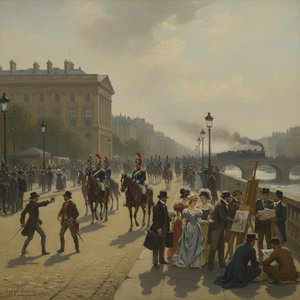
Émile Friant - A Life Rooted in Realism
Émile Friant (Dieuze, 16 april 1863 – Parijs, 6 juni 1932) was een Franse kunstschilder en graveur.- Early Life and Training
- Parisian Career and Salon Successes
- Mature Works: Portraits, Genre Scenes, and North African Influences
- Recognition and Honors
- Legacy
Early Life and Training
Émile Friant was born in Dieuze, France, to a family of a locksmith. From a young age he demonstrated an exceptional talent for drawing, nurtured by private tutors and subsequently under the guidance of Louis-Théodore Devilly at the Nancy school of drawing. Devilly’s insistence on direct observation and meticulous detail profoundly shaped Friant's artistic style—a realism imbued with emotional depth and psychological insight. He received a scholarship to study at Alexandre Cabanel’s atelier in Paris, where he was exposed to established academic techniques but also sought inspiration from Impressionist masters like Gêrome and Meissonier. His fascination for Bastien-Lepage’s dedication to nature further solidified his artistic vision.Parisian Career and Salon Successes
Friant quickly established himself in Paris, exhibiting regularly at the Salon and forging friendships with prominent actors such as Ernest Coquelin. A grant from the 1886 Salon enabled him to travel extensively—to Belgium, Holland, Italy, Malta and Tunisia—where he encountered the artistic heritage of the Dutch Masters. These journeys infused his landscapes with vibrant colors and a sense of exoticism, mirroring the broader cultural currents of the era. His participation in the 1889 Universal Exposition secured him a Gold Medal, cementing his reputation as one of France’s leading artists.Mature Works: Portraits, Genre Scenes, and North African Influences
Friant's artistic style was characterized by realism—a commitment to portraying everyday life with accuracy and sensitivity. His most celebrated works included *La Toussaint*, a poignant depiction of grief at a graveside that earned him the highest honor at the Salon. He excelled in portraiture, capturing not only physical likeness but also inner character and psychological state. Notably, he befriended Auguste Blain, who became his first biographer. Friant’s exploration of North Africa yielded stunning landscapes and portraits reflecting the region's cultural diversity.Recognition and Honors
Friant received numerous accolades throughout his career—including knighthood (1889), officer rank (1901) and commander rank (1931)—and was elected to the Institut de France, marking the pinnacle of artistic achievement in France. He continued to teach at the École des Beaux-Arts until his death in 1932.Legacy
Émile Friant is remembered as one of the last great naturalists—a painter who upheld a tradition of meticulous observation and emotional honesty amidst the rapid transformations of the early 20th century. His innovative use of photography as a preparatory tool demonstrated an engagement with technological advancements while maintaining his core artistic principles. His paintings continue to resonate with audiences today, embodying beauty, sensitivity, and enduring relevance—a testament to Friant’s profound contribution to French art history.Vraag & Antwoord
Hoe vind ik werken van Émile Friant met een specifiek thema?
Om werken van Émile Friant met een specifiek thema te vinden, kunt u de Op trefwoorden pagina van de kunstenaar gebruiken, waarop de kunstwerken per trefwoord zijn gegroepeerd.
Waar kan ik alle kunstwerken van Émile Friant bekijken?
Alle werken van Émile Friant op deze website zijn te bekijken op de Alle kunstwerken pagina van de kunstenaar.
In welke stad en welk land is Émile Friant geboren?
Émile Friant werd geboren in Dieuze, in Frankrijk.