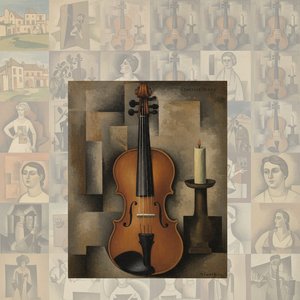
1906. Acrylic On Canvas.

§ 1Catalogue data


Dette kunstverket er beskyttet av opphavsrett
Kunstverket som vises på denne siden er beskyttet av opphavsretten, noe som betyr at vi ikke har juridisk tillatelse til å lage eller selge identiske reproduksjoner. Denne beskyttelsen håndheves i henhold til internasjonale avtaler som for eksempel Bernerkonvensjonen og av nasjonale lover, inkludert de som er fastsatt i Amerikansk lov om opphavsrett – Tittel 17.
Som et respektfullt og lovlig alternativ tilbyr vi skreddersydde, håndmalte kunstverk inspirert av originalen. Våre dyktige og profesjonelle kunstnere studerer nøye originalens stil, stemning og kunstneriske essens for å skape et nytt og unikt verk som vekker den samme følelsen – samtidig som det forblir en original skapelse i seg selv.
Denne metoden er i fullt samsvar med opphavsrettslige regler, da den ikke innebærer kopiering eller duplisering av det beskyttede kunstverket. I stedet er det snakk om en kreativ nytolkning – et nytt maleri som er inspirert av originalen, men ikke identisk med den.
 Les mer om dette
§ 2Abstract
Beskrivelse av objektet
This artwork is considered a seminal piece in the development of Cubism, marking Braque’s significant contribution to modern art history.
Om kunstneren
Georges Braque’s «Harbor i Normandie» (1909) revolusjonerte kubismen med fragmenterte former og dynamisk komposisjon – et tidløst kunstverk!
§ 3Commentary
Georges Braque’s Anatomical Exploration: “The Study of Nude”
Georges Braque's "The Study of Nude," created in 1906, stands as a cornerstone of early Cubism and exemplifies the artist’s groundbreaking approach to representing form and space. More than just a depiction of the human figure—a subject central to artistic tradition—this sketch delves into a profound investigation of perception itself, mirroring Braque's intellectual engagement with philosophical ideas surrounding simultaneity and fragmentation.- Subject Matter: The artwork centers on a nude female torso viewed from behind, subtly positioned within an intimate setting implied by two indistinct figures flanking her. This deliberate choice avoids idealized beauty, prioritizing anatomical accuracy and capturing the essence of human presence rather than presenting it as aesthetically pleasing.
- Style & Technique: Braque’s masterful use of charcoal or graphite—a technique favored for its ability to convey texture and tonal nuance—is paramount. The drawing employs hatching and cross-hatching extensively, creating a palpable sense of depth through layered shading that mimics the way light interacts with surfaces. These lines aren't merely delineating contours; they actively sculpt volume, mirroring Braque’s desire to break free from conventional perspective.
- Historical Context: Produced during the formative years of Cubism alongside Pablo Picasso, “The Study of Nude” reflects the burgeoning artistic movement’s rejection of illusionistic representation. Artists like Braque and Picasso wrestled with how to depict reality when viewed simultaneously from multiple viewpoints—a concept championed by philosophers like Henri Bergson—resulting in fractured planes and geometric shapes that challenge viewers' expectations.
- Symbolism & Emotional Impact: Beyond its technical prowess, the drawing resonates with a quiet contemplation. The woman’s posture conveys vulnerability and introspection, inviting viewers to consider themes of solitude and connection. The sketch’s immediacy speaks to the artist’s process—a spontaneous capture of form—and underscores Braque's commitment to exploring fundamental questions about visual perception.
- Detailed Analysis: Consider the deliberate flatness achieved through shading; it deliberately avoids creating a convincing illusion of depth, aligning with Cubist principles. The subtle interplay between hatching and crosshatching contributes significantly to the artwork’s textural quality, simulating the surface appearance of skin and fabric. Furthermore, observe how Braque utilizes simplified geometric forms in the background figures—a stylistic choice that reinforces the conceptual framework underpinning the piece.
Further Exploration & Reproduction Recommendations
For those captivated by Braque’s pioneering vision, AllPaintingsStore.com offers exceptional reproductions of “The Study of Nude,” meticulously crafted to preserve the artwork's original tonal palette and textural subtleties. Explore high-resolution prints on premium canvas or framed versions that elevate this seminal piece into a stunning centerpiece for any interior space—a testament to Braque’s enduring legacy in modern art history.Spørsmål og svar
Hvor kan jeg laste ned "The study of nude" av Georges Braque?
Nedlasting er tilgjengelig for "The study of nude": kunstverkets Last ned digitalt bilde-side tilbyr nedlasting av et digitalt bilde i høy oppløsning.
Finnes det en guide for "The study of nude" av Georges Braque?
Faktablad for studenter-siden for "The study of nude" av Georges Braque tilbyr et utskrivbart faktaark på to sider: kunstverket med sin identitetstabell, en tidslinje som plasserer det i kunstnerens levetid, andre verk av kunstneren, den målte fargepaletten og ferdigformaterte kildehenvisninger i fire stiler.
Hvor plasserer "The study of nude" seg i Georges Braque sitt samlede kunstnerskap?
"The study of nude" deler med Georges Braques andre verk sin Cubism-stil og de gjentakende temaene: analytical cubism, braque’s experimentation, formal exploration, geometric abstraction, proto-cubist influence.



 Bytt til trykk


 For kunstverk eller reproduksjoner som er større enn 105 cm (ca. 41 tommer) på noen side, vil rammen bli sendt som et sett som må monteres. Denne metoden sikrer trygg levering og forhindrer skader under transport.