The Soul of the Savoie: The Life and Art of Jacques Morion
Born in the heart of Chambéry on February 10, 1863, Jacques Morion was a painter whose brush captured the very essence of the French landscape and the quiet intimacy of human emotion. The son of a miller from the Hyères district, Morion’s early life was rooted in the industrious rhythms of the Savoie region, yet his spirit was destined for the ethereal realms of fine art. His journey began under the watchful eyes of mentors like Benoît-Hermogaste Molin, who recognized the burgeoning talent within the young student. By the age of sixteen, Morion had already distinguished himself, earning the prestigious prix Pillet-Will, a feat that signaled the arrival of a significant new voice in nineteenth-century French painting.
Driven by an insatiable thirst for artistic refinement, Morion departed his native Savoie in 1880 for the vibrant, competitive atmosphere of Paris. It was in this legendary capital that his technique underwent a profound transformation. Studying alongside masters such as Léon Germain Pelouse and Adrien Jourdeuil, he absorbed the nuances of light, shadow, and composition that would define his mature style. This period of Parisian training allowed him to blend the rugged, honest beauty of his Alpine roots with the sophisticated academic traditions of the era, creating a synthesis that was both grounded in reality and elevated by a dreamlike, almost symbolic sensibility.
A Mastery of Landscape and Light
Upon returning to Chambéry, Morion did not abandon his heritage; instead, he became its most devoted chronicler. While he continued to engage in the family business as a merchant miller, his true vocation remained at the easel. His work is characterized by an extraordinary devotion to the landscapes of the Savoie, particularly the serene waters of Lac du Bourget and Lac d'Aiguebelette. He possessed a rare ability to paint both in the controlled environment of the studio and en plein air, allowing him to capture the fleeting atmospheric shifts of the mountains and the delicate textures of the surrounding forests.
Morion’s repertoire was remarkably diverse, extending far beyond mere topography. He was a meticulous observer of life, capable of rendering:
- Evocative Landscapes: From the misty valleys of Chamonix to the sun-dappled streams of his youth, his landscapes possess a profound sense of place and peace.
- Intimate Portraits: A gifted portraitist, he infused his subjects—including his own family members—with a psychological depth that transcended simple likeness.
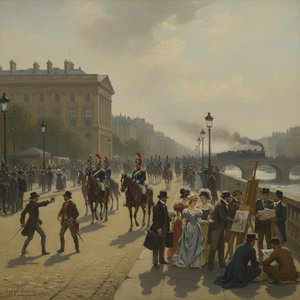
- Genre Scenes: His canvases often featured animated, romanticized scenes of daily life, capturing the quiet dignity of the provincial existence.
- Religious and Symbolic Themes: In certain works, one can sense the influence of French Symbolism, where light and shadow serve to evoke a deeper, more spiritual narrative.
Legacy and Historical Significance
The professional trajectory of Jacques Morion was marked by significant institutional recognition. His membership in the Union Artistique and his later induction into the Artistes Français underscored his standing within the French art establishment. He was a regular presence in the prestigious salons of Lyon and the Champs-Élysées in Paris, bringing the quiet majesty of the Alps to the wider world. Furthermore, his role as a teacher at the school of painting in Chambéry, succeeding Jules Daisay, ensured that his technical precision and passion for the regional landscape would be passed down to a new generation of artists.
Though his life was tragically short, ending in 1904 at the age of forty-one, Morion left behind a body of work that remains a vital link to the nineteenth-century French tradition. His paintings are more than mere records of scenery; they are emotional landscapes that invite the viewer to experience the timeless beauty of the Savoie. Today, his legacy lives on through the enduring charm of his compositions, which continue to resonate with those seeking the poetic intersection of nature and human spirit.
Spørsmål og svar
Finnes det en kronologisk oversikt over Morion Jacques?
En kronologisk oversikt over Morion Jacques sitt arbeid er tilgjengelig på kunstnerens Karriereløp-side, hvor verkene presenteres i rekkefølge etter når de ble skapt, kapittel for kapittel.
Hvor populære er kunstverkene til Morion Jacques?
Siden Besøksstatistikk for Morion Jacques presenterer statistikk beregnet ut fra kunstverkene til kunstneren som er oppført på denne nettsiden.
Kan jeg bla gjennom verkene til Morion Jacques etter kunstretning?
Se kunstretningene Morion Jacques arbeidet innen på kunstnerens Alle kunstretninger-side, hvor verkene er gruppert etter stilretning.