A Vision of the Global Landscape: The Life and Art of Andreas Gursky
Born in Leipzig, East Germany, in 1955, Andreas Gursky’s artistic journey is inextricably linked to the shifting political landscape of post-war Europe. His family's relocation to West Germany in 1957, settling first in Essen and then Düsseldorf, proved formative, not only geographically but also professionally. Both his father, Willy Gursky, and grandfather, Hans Gursky, were photographers, instilling within him a deep understanding of the medium from an early age. This familial legacy provided a foundation upon which he would build a career that redefined
contemporary photography. Gursky’s initial studies at Folkwang University of the Arts in Essen (1978-1981) exposed him to a more subjective approach, influenced by photographers like
Otto Steinert and Michael Schmidt. However, it was his subsequent enrollment at the Kunstakademie Düsseldorf (1981-1987), under the tutelage of Bernd and Hilla Becher, that truly shaped his artistic trajectory. The Bechers’ meticulous, objective documentation of industrial architecture – their systematic cataloging of water towers, blast furnaces, and gas tanks – instilled in Gursky a rigorous approach to image-making, emphasizing clarity, precision, and an almost anthropological detachment.
From Industrial Documentation to Global Perspectives
Gursky’s early work reflected the influence of his mentors, with series like *Pförtnerbilder* (1981–85) focusing on security personnel in office buildings – a subtle exploration of
power dynamics and surveillance within the modern workplace. He also turned his lens to the industrial heartland of the Ruhr Valley, documenting the interplay between nature and industry. However, around 1988, Gursky began experimenting with larger photographic formats, a pivotal shift that would become a defining characteristic of his style. This coincided with the burgeoning digital revolution, and in the 1990s, he embraced digital manipulation techniques, combining images and perspectives to create highly detailed, often abstract compositions. This wasn’t simply about altering reality; it was about revealing underlying structures and patterns that are normally invisible to the naked eye. Influenced by
British landscape photographer John Davies' high vantage point images, Gursky began to elevate his perspective, offering viewers a
panoramic view of contemporary life. He also acknowledged a lesser influence from American photographer
Joel Sternfeld, whose work contributed to his developing aesthetic sensibility. This combination of technical innovation and conceptual rigor allowed him to move beyond mere documentation towards a more profound exploration of globalization, consumerism, and the relationship between individuals and large-scale systems.
Iconic Images and Recurring Themes
Andreas Gursky’s work is instantly recognizable for its scale, detail, and often unsettling beauty. Images like *99 Cent* (1999), a vibrant depiction of the interior of a 99-cent store, are not simply records of consumer culture; they are meticulously constructed compositions that transform
everyday objects into fields of color and pattern. *Rhein II* (1999), perhaps his most famous work, exemplifies his mastery of digital manipulation. The image of the Rhine River was extensively altered to create abstract bands of color, blurring the line between reality and artifice. This photograph not only achieved a record-breaking auction price – over $4 million – but also sparked debate about the nature of photography in the digital age. *
Sha Tin* (2004), showcasing densely populated housing in Hong Kong, is another powerful example of his ability to capture the overwhelming scale and complexity of modern
urban life. Recurring themes throughout Gursky’s oeuvre include the anonymity of contemporary spaces – shopping malls, factories, office buildings – and the feeling of being overwhelmed by information and choice. His *Ocean I-VI* (2009-2010) series pushed the boundaries of photographic representation even further, utilizing high-definition satellite photographs augmented with internet sources to create vast, almost abstract depictions of the world’s oceans.
Legacy and Impact on Contemporary Art
Andreas Gursky has received numerous accolades throughout his career, including the Förderpreis des Landes Nordrhein-Westfalen für junge Künstler (1988), the Citibank Private Bank Photography Prize (1998), and the Infinity Award for Art from the International Center of Photography (2001). However, his true legacy lies in his profound impact on
contemporary photography. He is widely considered one of the most important photographers of his generation, significantly expanding the possibilities of the medium through his large-scale prints and innovative use of digital manipulation. His work has influenced a wide range of artists working with photography and other media, and he is often associated with the “Düsseldorf School” of photography, alongside
Thomas Ruff and
Thomas Struth. Gursky’s photographs command high prices in the art market, reflecting their critical acclaim and cultural significance. More importantly, his work continues to be exhibited internationally and remains a subject of scholarly study, solidifying his place as a pivotal figure in
contemporary art history – an artist who has not only documented our world but also challenged us to see it in new and unexpected ways.
His ability to transform the mundane into the monumental, and the real into the abstract, ensures that his work will continue to resonate with audiences for generations to come.


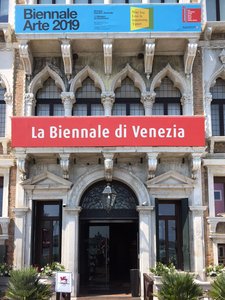 la Biennale di Venezia