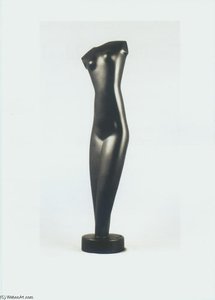
Resposta rápida
A pintura mais famosa de Alexander Archipenko é The Boxers (La Lutte) (1914). Mask (1911) e Woman combing her hair (1914) são os números dois e três. Dos 43 trabalhos de Alexander Archipenko em nosso catálogo, estas são as 43 obras mais famosas, classificadas com o seu respectivo ano e museu, para que possa escolher a pintura para encomendar.
As 10 principais pinturas de Alexander Archipenko, classificadas
Pinturas de Alexander Archipenko classificadas de 11 a 43
Pinturas de Alexander Archipenko por tema
Os quatro temas mais frequentes neste ranking, com a principal obra de cada um.
Women 11 obras
Nudes 7 obras
Royalty 3 obras
Abstract form 2 obras
Museus que possuem obras originais de Alexander Archipenko
Os 3 museus que detêm a maioria das pinturas desta página.
| Museus | Cidade | Obras de Alexander Archipenko | Pinturas desta lista |
|---|---|---|---|
| Washington, D.C. | 1 | Standing Woman | |
| Hamilton | 1 | Woman with Fan | |
| Oldenburg | 1 | Geometry |
Alexander Archipenko por década: a principal pintura de cada uma
Pinturas de Alexander Archipenko: perguntas frequentes
Qual é a pintura mais famosa de Alexander Archipenko?Ver resposta
The Boxers (La Lutte) (1914) ocupa o primeiro lugar, seguido por Mask (1911) e Woman combing her hair (1914).
Qual era a idade de Alexander Archipenko quando The Boxers (La Lutte) foi pintada?Ver resposta
Alexander Archipenko tinha 27 anos: The Boxers (La Lutte) é datada de 1914, e Alexander Archipenko nasceu em 1887.
Quais são as 10 principais pinturas de Alexander Archipenko?Ver resposta
The Boxers (La Lutte), Mask, Woman combing her hair, Standing Woman, Carafe, The Past, Nude, Seated Female Nude (Black Torso), Sorrow e The Gondolier. O ano e o museu de cada uma estão no ranking acima.
Quantas obras de Alexander Archipenko você tem listadas?Ver resposta
43 obras de Alexander Archipenko estão em nosso catálogo, datadas de 1909 a 1963.
Onde estão guardadas as pinturas originais de Alexander Archipenko?Ver resposta
Principalmente em The Phillips Collection (Washington, D.C.), Art Gallery of Hamilton (Hamilton) e Oldenburg State Museum for Art and Cultural History (Oldenburg). Consulte a tabela de museus acima para a lista completa.
Qual período produziu as pinturas mais famosas de Alexander Archipenko?Ver resposta
Em 1910s: 12 das 43 pinturas classificadas aqui datam dessa época, incluindo The Boxers (La Lutte).
Quais são as pinturas mais antigas e mais recentes do(a) famoso(a) Alexander Archipenko?Ver resposta
Mais antiga nesta página: Sorrow (1909). Mais recente: King Solomon (1963).
Quais são os principais temas das pinturas de Alexander Archipenko?Ver resposta
Entre as 43 pinturas classificadas aqui: Women (11), Nudes (7) e Royalty (3).
Com qual movimento Alexander Archipenko está associado(a)?Ver resposta
Cubism, com base nas pinturas classificadas nesta página.
Sobre o artista: Alexander Archipenko
A Pioneer of Cubist Sculpture: The Life and Art of Alexander Archipenko
Alexander Porfyrovych Archipenko, born in Kyiv, Ukraine, on May 30, 1887, was a truly revolutionary figure in the world of sculpture. His journey wasn’t simply one of artistic creation; it was a bold confrontation with established norms, a relentless pursuit of new forms and ways of seeing. From his early training at the Kyiv Art School to his eventual recognition as a leading voice in the avant-garde, Archipenko's life was marked by an unwavering commitment to innovation and a profound impact on the trajectory of modern art. His story begins amidst the vibrant artistic ferment of his native city, a place that would nurture his initial explorations before propelling him onto the international stage.- Early Influences: Archipenko’s formative years in Kyiv exposed him to a rich tapestry of artistic traditions – Ukrainian folk art, Byzantine iconography, and the classical sculptures of antiquity. These influences, combined with his formal training at the Kyiv Art School, provided a foundation for his later experimentation.
- Serhiy Svetoslavsky: A pivotal mentor, Serhiy Svetoslavsky, instilled in Archipenko a deep appreciation for theatricality and movement, concepts that would profoundly shape his sculptural approach.
- Early Exhibitions: Even before his relocation to Paris, Archipenko demonstrated an independent spirit, exhibiting alongside Alexander Bogomazov in 1906 – a clear signal of his burgeoning artistic ambitions.
The Parisian Awakening: Embracing Cubism and the Avant-Garde
In 1908, Archipenko made the decisive move to Paris, a city that would become the crucible for his artistic transformation. Rejecting the rigid structures of the École des Beaux-Arts, he immersed himself in the vibrant, rebellious atmosphere of La Ruche, a collective of artists pushing against the boundaries of convention. It was here, amongst fellow innovators like Fernand Léger and Vladimir Baranoff-Rossinè, that Archipenko truly found his voice. The influence of Cubism was immediate and profound. He didn’t merely replicate painting's fractured perspectives in three dimensions; he sought to fundamentally redefine sculpture itself.- Rejection of Traditional Forms: Unlike traditional sculptors who focused on solid mass and volume, Archipenko began exploring the power of *negative space* – voids that became integral components of his compositions. This daring approach challenged the very definition of form, suggesting that a sculpture could be defined as much by what wasn’t there as by what was.
- La Ruche: The artistic community at La Ruche provided Archipenko with a crucial environment for experimentation and collaboration, fostering an atmosphere of intellectual freedom and radical creativity.
Deconstructing Form: Sculpto-Paintings and the Exploration of Space
Archipenko’s artistic vision was profoundly shaped by Cubism, yet he wasn't content merely to translate painting’s fractured perspectives into three dimensions. He sought to fundamentally redefine sculpture itself. Where traditional sculptors focused on solid mass and volume, Archipenko began exploring the power of *negative space* – voids that became integral components of his compositions. This daring approach challenged the very definition of form, suggesting that a sculpture could be defined as much by what wasn’t there as by what was. He masterfully manipulated convex and concave surfaces, creating dynamic interplay of light and shadow, imbuing his works with an unprecedented sense of movement and energy. This innovative spirit led to the creation of “sculpto-paintings,” where he boldly incorporated painted color onto intersecting planes, blurring the lines between sculpture and painting. Inspired by Cubist collage techniques, Archipenko further expanded his material palette, incorporating glass, wood, and metal into his sculptures – most notably in his captivating "Medrano" series depicting circus performers. These works weren’t simply representations of figures; they were investigations into the very essence of sculptural possibility.- The “Scupto-Painting” Technique: Archipenko's innovative approach involved layering painted color onto intersecting planes, creating a dynamic interplay between sculpture and painting – a technique that further blurred the boundaries of artistic expression.
- Material Experimentation: The "Medrano" series exemplifies Archipenko’s willingness to experiment with unconventional materials, including glass, metal, and painted wood, resulting in works that were both visually striking and conceptually complex.
Major Works and Lasting Influence
Throughout the 1910s, Archipenko produced a series of seminal works that cemented his reputation as a leading figure in modern sculpture. Family Life (1912), an early example of his Cubist approach to the human form, showcases fragmented planes and abstracted figures, capturing a sense of domestic intimacy through geometric deconstruction. Walking Woman (1912) exemplifies his innovative use of voids, creating a dynamic impression of movement as if the figure is perpetually in motion. Boxing Match (1913), with its abstract cubic and ovoid forms, powerfully conveys the energy and brutality of the sport. The “Medrano” series, inspired by the vibrant world of the circus, stands out for its unconventional use of materials – glass, metal, and painted wood – creating a collage-like effect that further blurred the boundaries between sculpture and other art forms. Later in his career, Archipenko undertook monumental projects like the King Solomon Statue (University of Pennsylvania), demonstrating his continued exploration of abstract forms and geometric principles on a grand scale. These works weren’t merely aesthetic statements; they were intellectual explorations into the nature of perception and representation.- Family Life: A pivotal early work that demonstrated Archipenko's ability to capture human emotion through fragmented, Cubist forms.
- Walking Woman: Showcased his innovative use of voids, creating a sense of dynamic movement and challenging traditional sculptural conventions.
- Boxing Match: An abstract representation of the sport, emphasizing energy and dynamism through geometric shapes.