Garantia de Reembolso · 30 dias Entrega gratuita para todo o mundo
446.261obras de arte 30.640artistas 4.753museus 32idiomas
País
Moeda
Idioma
Ateliê · Desde 2015 · Paris, França
AllPaintingsStore
allpaintingsstore.com
Minha conta Lista de desejos Carrinho

Christopher Richard Wynne Nevinson

1889 - 1946

Resumo Biográfico

  • Copyright status: Public domain
  • Works on APS: 96
  • Top 3 works:
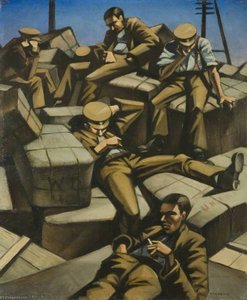
    • Dog Tired
    • Notre Dame de Paris from Quai des Grands Augustins
    • Blackfriars Bridge, London
  • Mediums:
    • acrílico sobre tela
    • óleo sobre tela
  • Lifespan: 57 years
  • Room fit: sala de estar
  • Nationality: Reino Unido
  • Gift suitability: other-none
  • Vibe:
    • calmo
    • sereno
  • Ver mais…
  • Top-ranked work: Dog Tired
  • Best occasions: acento de cor
  • Museums on APS:
    • Museu Ashmolean de Arte e Arqueologia
    • Museu Ashmolean de Arte e Arqueologia
    • Museu Ashmolean de Arte e Arqueologia
    • Museu Ashmolean de Arte e Arqueologia
    • Museu Ashmolean de Arte e Arqueologia
  • Creative periods: wwi era
  • Also known as:
    • C.R.W. Nevinson
    • Richard Nevinson
  • Died: 1946
  • Born: 1889, Londres, Reino Unido
  • Art period: Modernismo
  • Movements: cubism

Teste de Arte

Cada pergunta possui apenas uma resposta correta.

Pergunta 1:
Quem foi o pai de Christopher Richard Wynne Nevinson?
Pergunta 2:
Em que capacidade Nevinson inicialmente serviu durante a Primeira Guerra Mundial?
Pergunta 3:
Qual estilo artístico influenciou fortemente os primeiros trabalhos de guerra de Nevinson?
Pergunta 4:
Nevinson é considerado um dos artistas mais importantes da Primeira Guerra Mundial devido à sua abordagem inovadora em relação a:
Pergunta 5:
Como foi descrito o estilo artístico de Nevinson pelos seus colegas artistas?

Early Life and Artistic Awakening

Christopher Richard Wynne Nevinson, known as C.R.W. Nevinson or simply Richard Nevinson, emerged onto the British art scene at a moment of profound societal shift. Born in 1889 in Hampstead, London, his upbringing was steeped in intellectual and progressive ideals. His father, Henry Nevinson, was a renowned war correspondent and journalist, while his mother, Margaret Nevinson, dedicated herself to the burgeoning suffrage movement as a writer and activist. This environment instilled in young Richard a keen awareness of social issues and a spirit of independent thought that would permeate his artistic vision. Though initially struggling to find direction, he eventually enrolled at the Slade School of Art in 1909, studying under Henry Tonks alongside future luminaries like Stanley Spencer and Mark Gertler. While Tonks encouraged traditional techniques, Nevinson found himself drawn towards more radical currents, seeking a visual language that could capture the dynamism of the modern world. Early influences included the work of Augustus John, but it was his encounter with the Italian Futurists and Wyndham Lewis that truly ignited his artistic trajectory.

Embracing Modernity: Futurism, Vorticism, and the Brink of War

Nevinson’s artistic development took a decisive turn when he befriended Filippo Marinetti, the charismatic leader of the Italian Futurist movement. Captivated by Futurism's celebration of speed, technology, and the energy of urban life, Nevinson began to incorporate its principles into his own work. He briefly aligned himself with Wyndham Lewis’s Rebel Art Centre, a hub for avant-garde experimentation in London. However, this association was short-lived. A fundamental disagreement over artistic direction led to a rift between Nevinson and Lewis, resulting in Nevinson's exclusion from the Vorticist movement—a distinctly British offshoot of Futurism founded by Lewis himself. Despite this falling out, Nevinson continued to explore Futurist ideas, even co-authoring a manifesto for English Futurism alongside Marinetti. His early paintings reflected these influences, depicting scenes of modern London – bustling streets, railway stations, and the nascent Underground system – with fragmented forms and dynamic compositions. These works weren’t merely representations of place; they were attempts to convey the *feeling* of modernity—its exhilarating pace and relentless energy. Alongside his exploration of Futurist aesthetics, Nevinson maintained close ties with artists like Mark Gertler and Dora Carrington, sharing a brief period of artistic kinship rooted in Neo-Primitivism before diverging onto their individual paths.

The Horrors of War and the Rise of a War Artist

The outbreak of World War I irrevocably altered Nevinson’s artistic focus. Initially joining the Friends' Ambulance Unit, he witnessed firsthand the brutal realities of war while tending to wounded French and British soldiers. Illness forced his return to Britain, but he soon volunteered with the Royal Army Medical Corps. He used these experiences as the subject matter for a series of powerful paintings which utilized the machine aesthetic of Futurism and the influence of Cubism to great effect. Bleak, outspoken and often angry, his work from 1915–16 stands as powerful testaments to the devastation of modern warfare. Paintings like La Mitrailleuse (The Machine Gunner), created in 1915, employed fragmented forms and jarring perspectives to convey not just the physical destruction but also the psychological trauma inflicted by mechanized conflict. His fellow artist Walter Sickert wrote at the time that Nevinson's painting *La Mitrailleuse*, 'will probably remain the most authoritative and concentrated utterance on the war in the history of painting.' He was officially appointed an official war artist in 1917, but he struggled to recapture the critical acclaim he had achieved during the war.

Post-War Years: Travels, Turmoil, and Legacy

Following World War I, Nevinson travelled extensively, documenting his observations of New York City and exploring landscapes across Europe. However, his reputation suffered a significant blow after publishing his memoir *Paint and Prejudice*, which was marred by inaccuracies and inconsistencies. Despite these setbacks, Nevinson remained a respected figure in British art history. He is recognized as one of the most important war artists of World War I, whose innovative use of Futurist and Cubist techniques brought a new level of intensity and emotional depth to depictions of conflict. His exploration of speed, technology, and urban life anticipated many of the themes that would dominate 20th-century art. He died in London in October 1946, leaving behind a legacy as a visionary artist who dared to confront the complexities of his time.