The Sublime Vision of Edward Train
In the grand tapestry of nineteenth-century landscape painting, few threads are as evocative and atmospheric as those woven by Edward Train. A pioneer of the Romantic movement, Train possessed a rare ability to translate the raw, untamed majesty of the natural world onto canvas, creating works that do more than merely depict scenery—they evoke an emotional response to the infinite. Born in Edinburgh in 1801, his early life was deeply rooted in the rugged landscapes of Scotland. This formative immersion in the Highlands, with its mist-shrouded lochs and towering, heather-clad peaks, instilled in him a lifelong fascination with the sublime—that specific aesthetic quality where beauty meets a sense of overwhelming, even terrifying, grandeur.
Train’s artistic journey was shaped by a rigorous classical foundation. His education at Eton College provided a scholarly backdrop to his developing sensibilities, but it was his time at William Hayley’s Academy in Bury St Edmunds that truly refined his technical prowess. Under the guidance of influential instructors, he mastered the delicate interplay of light and shadow, a skill that would later become the hallmark of his mature style. As his talent blossomed, Train sought broader horizons, eventually embarking on a transformative transatlantic journey in 1830. Settling in New York City, he bridged the gap between the old-world traditions of Europe and the burgeoning artistic energy of America, establishing himself as a respected figure within the American art scene while maintaining his profound Scottish soul.
Technique and the Romantic Spirit
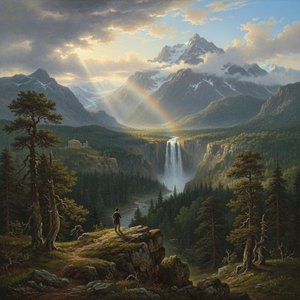
The magic of a Train masterpiece lies in the seamless marriage of meticulous observation and expressive, fluid brushwork. He was a master of oil on canvas, utilizing complex layering and blending techniques to achieve a luminous, almost ethereal quality in his light sources. Whether capturing the sun breaking through heavy storm clouds or the soft, diffused glow of a mountain morning, Train’s use of color was both precise and deeply emotive. His compositions were never static; they were designed to lead the viewer's eye through dramatic vistas, often emphasizing scale and depth to make the spectator feel small in the face of nature's power.
His thematic focus remained steadfastly tied to the elements of water and stone. In works such as Mountain Torrent and A Scottish Waterfall, one can sense the kinetic energy of rushing water crashing against ancient rock. He had a particular talent for rendering the textures of the natural world—the ruggedness of granite, the softness of moss, and the translucent spray of a waterfall. This dedication to capturing the physical essence of his subjects allowed him to embody the Romantic ideal: the belief that nature is a mirror to the human spirit, capable of reflecting both our deepest peace and our most profound awe.
Legacy and Historical Significance
Though the era of pure Romanticism eventually gave way to new artistic movements, the legacy of Edward Train remains etched in the history of landscape art. He stands as a vital link between the classical traditions of the British school and the developing landscape sensibilities of the United States. His ability to navigate two different worlds allowed him to bring a sophisticated European sensibility to American subjects, enriching the cultural landscape of the mid-nineteenth century.
Today, his works serve as windows into a vanished era of exploration and reverence for the wild. To view a Train painting is to participate in a historical dialogue with the earth itself. His contributions are characterized by:
- The Mastery of Atmosphere: An unparalleled ability to use light to create mood and depth.
- Cross-Continental Influence: The successful integration of Scottish Romanticism into the American art market.
- Emotional Resonance: A lifelong commitment to capturing the sublime power of the natural landscape.
Through his enduring canvases, Edward Train continues to remind us of the profound connection between the human eye and the magnificent, untamed beauty of our world.
Perguntas e Respostas
Quantas obras de Edward Train estão disponíveis para explorar?
Você pode explorar 10 obras de arte obras de Edward Train na página Todas as obras.
Quais obras de Edward Train são as mais visualizadas?
As estatísticas sobre as obras de Edward Train estão disponíveis na página de Estatísticas do artista.
Em quais movimentos Edward Train atuou?
Os movimentos em que Edward Train atuou podem ser conferidos na página de Todos os Movimentos do artista, que agrupa as obras por movimento.