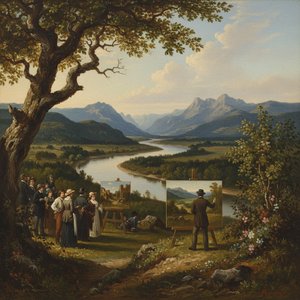
Faustin Besson: Capturing Parisian Life Through Realistic Portraiture
Faustin Besson (1821-1882) stands as a pivotal figure in French art history, particularly renowned for his masterful depictions of Parisian society during the Belle Époque – an era characterized by optimism and artistic innovation. Born into a family of artists, Besson’s formative years instilled within him a deep appreciation for observation and meticulous detail, qualities that would become hallmarks of his distinctive artistic style. While biographical information remains somewhat sparse compared to contemporaries like Alexandre Cabanel or Gustave Courbet, Besson's legacy rests firmly on the enduring power of his portraits and genre scenes, offering invaluable insights into the cultural landscape of late 19th-century France.- Early Life & Artistic Training: Besson’s father, Jean Séraphin Désiré Besson, was a sculptor who instilled in Faustin a passion for artistic pursuits from a young age. He received his initial training under Alexandre Cabanel, arguably the most celebrated portraitist of his time, absorbing Cabanel's techniques for capturing psychological nuance and conveying emotion through subtle facial expressions.
- Style & Technique: Besson’s artistic approach distinguished itself from prevailing trends toward grand historical narratives. Instead, he focused on portraying everyday life – scenes of Parisian cafes, family gatherings, and intimate interiors – rendered with remarkable realism. He employed a meticulous technique characterized by careful layering of glazes and subtle tonal variations, achieving luminous surfaces that captured the atmosphere of his subjects’ environments.
Notable Works & Artistic Development
Besson's oeuvre comprises approximately 150 paintings, predominantly portraits and genre scenes. Among his most celebrated works is “Portrait de Jean Séraphin Désiré Besson,” a self-portrait that exemplifies his stylistic principles—a testament to his dedication to capturing the essence of human character with unwavering precision. His artistic development progressed steadily throughout his career, refining his technique and expanding his repertoire of subjects. He skillfully blended academic conventions with expressive considerations, demonstrating an ability to convey both formal elegance and emotional depth.- Key Subjects: Besson’s portraits frequently depicted prominent figures from Parisian intellectual circles – writers, artists, musicians, and statesmen—capturing their personalities with sensitivity and accuracy. He also excelled in portraying familial scenes, depicting families engaged in domestic activities with warmth and realism.
- Influences: Besson's artistic sensibilities were undoubtedly shaped by the Impressionists, whose emphasis on capturing fleeting moments of light and color resonated with his desire to convey atmosphere and emotion. However, he maintained a steadfast commitment to traditional compositional structures and meticulous rendering techniques.
Historical Significance & Legacy
Faustin Besson’s contribution to French art is significant not merely for the sheer volume of his output but also for his role in establishing realism as a dominant aesthetic within portraiture. He championed a style that prioritized psychological observation and tonal subtlety, influencing subsequent generations of artists. His paintings continue to be admired for their beauty and artistic integrity, serving as enduring representations of Parisian life during the Belle Époque—a period remembered for its cultural vibrancy and artistic dynamism. Besson’s legacy persists as an exemplar of artistic excellence and a celebration of human experience.Perguntas e Respostas
A qual período histórico pertence a obra de Faustin Besson?
Faustin Besson atuou no período 19th Century. Este período situa a atividade do artista na história.
Quais obras de Faustin Besson são as mais visualizadas?
Existe uma página de Estatísticas para Faustin Besson, apresentando estatísticas sobre as obras do artista no este site.
Posso explorar as obras de Faustin Besson por espectro de cores?
As obras de Faustin Besson podem ser exploradas por cor na página Índice de Cores do artista.