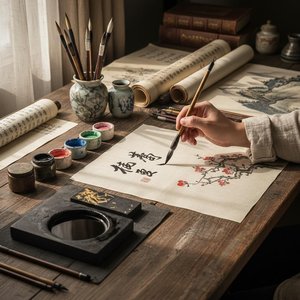
The Spiritual Breath of the Brush
Keinin Sumiyoshi (1ict535–1619) was far more than a master of ink and color; he was a spiritual voyager whose artistry served as an extension of his profound Buddhist devotion. Born in the cultural heart of Kyoto, Sumiyoshi emerged during the Muromachi period as a cornerstone of the esteemed Sumiyoshi school, a movement deeply rooted in the sanctity of the Sumiyoshi Taisha shrine. His work transcends simple representation, acting instead as a meditative conduit between the earthly and the divine. Through his hands, the act of painting became a form of prayer, where every meticulous stroke on silk was intended to capture the profound emptiness and spiritual resonance central to Zen philosophy.The Architecture of Nature and Emotion
The true brilliance of Sumiyoshi’s oeuvre lies in his ability to render the natural world with a precision that feels both hyper-realistic and deeply symbolic. His landscapes, characterized by sweeping mountainous vistas and intricate details, invite the viewer into a realm of quiet contemplation. He possessed an unparalleled skill for capturing the ruggedness of stone, the delicate translucency of water, and the rhythmic patterns of foliage, yet he never allowed technical mastery to overshadow emotional depth. In his hands, a single ripple in a stream or the shadow on a mountain peak becomes a vessel for inner states of mind, reflecting the transient beauty of existence.While his technique was grounded in the rigorous traditions of his school, Sumiyoshi’s approach was uniquely characterized by several key elements:
- Meticulous Detail: The use of fine ink lines to create an immersive and tactile environment.
- Spiritual Symbolism: Integrating religious figures, such as the Rakan, into natural settings.
- Atmospheric Depth: Utilizing color and space to evoke the vastness of the Zen cosmos.