Garantia de Reembolso · 100 dias Entrega gratuita para todo o mundo
612.379obras de arte 52.886artistas 5.406museus 32idiomas

Thomas Greig

Informações principais

  • Top 3 works:
    • Waiting for High Water
    • Portrait of a Negress
    • Steelworks
  • Copyright status: Under copyright
  • Works on this site: 5
  • Typical colors: tons terrosos
  • Top-ranked work: Waiting for High Water

A Life Immersed in British Scenes: The World of Thomas Greig

Thomas Greig, a name resonating within the annals of 19th-century British art, stands as a compelling chronicler of his era. While biographical details remain somewhat elusive – a common trait for artists whose fame rests more on their canvases than personal notoriety – Greig’s work speaks volumes about his keen observation and dedication to portraying the evolving landscape of Victorian Britain. He wasn't merely painting scenes; he was documenting a nation in flux, capturing the spirit of industrial progress alongside the enduring beauty of rural life. His paintings offer a fascinating glimpse into a period defined by both rapid change and steadfast tradition.

The Rise of an Industrial Painter

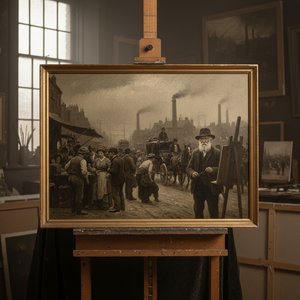
Greig’s artistic focus centered on the burgeoning industries that were reshaping England. Steelworks, factories, and bustling urban scenes became his primary subjects. This wasn't simply a matter of documenting progress; Greig imbued these industrial settings with a sense of drama and human presence often absent in purely topographical depictions. His Steelworks, for example, isn’t just an image of machinery and smoke; it’s a vibrant tableau of labor, energy, and the sheer scale of Victorian enterprise. The fiery glow illuminating the faces of workers, the intricate details of the iron structures, all contribute to a powerful narrative about the human cost and ambition inherent in industrialization. He wasn't necessarily making a political statement, but his work implicitly acknowledges the social impact of these changes.

Portraits and Historical Echoes

Beyond industry, Greig demonstrated a talent for portraiture and historical scenes. These works reveal a mastery of technique and an ability to capture not just likeness, but also character and emotion. While less frequently discussed than his industrial paintings, they showcase a versatility that underscores his skill as an artist. His portraits often depict individuals connected to the world he so meticulously documented – factory owners, merchants, or members of the growing middle class. These are not grand, idealized portrayals; rather, they feel grounded and realistic, offering intimate glimpses into the lives of those shaping Victorian society. The historical scenes, though fewer in number, suggest a fascination with England’s past and a desire to connect the present with its rich heritage.

Influences and Artistic Development

Pinpointing specific artistic influences on Greig is challenging due to limited documentation. However, one can discern echoes of the Realist movement within his work – a commitment to depicting subjects as they are, without romanticization or idealization. Artists like Gustave Courbet, who championed everyday life and social realism, likely resonated with Greig’s approach. Furthermore, the topographical tradition in British art, exemplified by painters such as J.M.W. Turner and John Constable, undoubtedly played a role in shaping his landscape sensibilities. He seems to have synthesized these influences, creating a unique style that blended realistic detail with a dramatic sense of atmosphere.

Legacy and Historical Significance

Thomas Greig’s legacy lies not in groundbreaking innovation but in the consistent quality and insightful portrayal of Victorian life. His paintings serve as invaluable historical documents, offering a visual record of an era undergoing profound transformation. He captured the energy, ambition, and social complexities of 19th-century Britain with remarkable skill and sensitivity. While perhaps not a household name today, his work continues to captivate viewers with its authenticity and evocative power. His paintings are found in museums and private collections, ensuring that his vision of Victorian England endures for generations to come.

Perguntas e Respostas

Existe um guia de estudo para uma pintura de Thomas Greig?

Sim. Consulte o guia de estudo de Waiting for High Water, uma ficha técnica para impressão.

A obra de Thomas Greig está em domínio público?

Não. As obras de Thomas Greig ainda estão protegidas por direitos autorais.

Existe uma cronologia da carreira de Thomas Greig?

Veja a trajetória de Thomas Greig período a período, com as obras de cada etapa.

Quais cores Thomas Greig utilizou com mais frequência?

Veja as cores que Thomas Greig mais utilizou, analisadas através das suas obras.

Posso explorar as obras de Thomas Greig por espectro de cores?

Veja as obras de Thomas Greig ordenadas por cor, por todo o espectro.

Onde posso explorar as obras de Thomas Greig mapeadas por tema?

Veja os temas que Thomas Greig pintou, mapeados em todas as obras.

Posso visitar um museu virtual das obras de Thomas Greig?

Por quais pinturas Thomas Greig é conhecido(a)?

Thomas Greig é conhecido pelas obras listadas em as pinturas mais famosas de Thomas Greig.

Posso navegar pelas obras de Thomas Greig por humor?

Veja as obras de Thomas Greig organizadas por humor: cada obra é selecionada de acordo com a sua atmosfera.