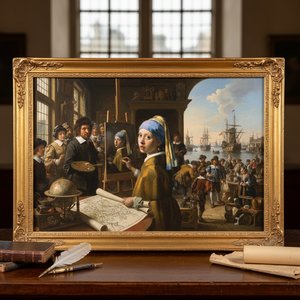
1656. Oil On Canvas, 80.0 x 65.0 cm. Muzeele Statale din Berlin.

§ 1Catalogue data

- 80.0 x 65.0 cm


§ 2Abstract
Descriere obiect de colecție
Bernard Pietersz Fabritius's 'The Slaughtered Pig' (1656) offers a stark glimpse into daily life. Explore the Dutch Baroque painting's details & artistry at AllPaintingsStore.
 Vezi mai mult
Biografie artist
Discover Bernard Pietersz Fabritius (1624-1673), a Dutch Baroque painter known for poignant portraits & biblical scenes like 'The Young Painter.' Explore his masterful works!
§ 3Commentary
Bernard Pietersz Fabritius's "The Slaughtered Pig": A Glimpse into Dutch Domesticity
Bernard Pietersz Fabritius’s “The Slaughtered Pig,” painted in 1656, is far more than a simple depiction of a rural scene; it’s a poignant window into the daily life and social customs of 17th-century Netherlands. This black and white artwork, measuring 80 x 65 cm, currently housed within the Staatliche Museen in Berlin, showcases Fabritius's remarkable ability to capture intimate moments with striking realism and subtle psychological depth. The painting’s monochromatic palette, unusual for its time, lends a starkness and immediacy to the scene, drawing the viewer directly into the heart of this domestic ritual. It is not merely about the act of slaughtering an animal; it’s about community, labor, and the cyclical nature of life and sustenance.A Masterful Study in Light and Shadow
Fabritius was renowned for his exceptional handling of light and shadow – a hallmark of the Dutch Baroque style – and “The Slaughtered Pig” exemplifies this skill beautifully. The absence of color doesn't diminish the richness of the artwork; instead, it amplifies the interplay of tones, creating a dramatic chiaroscuro effect that emphasizes textures and forms. Notice how the light falls upon the woman’s face, highlighting her expression – a mixture of weariness and quiet determination. The rough texture of the pig’s skin contrasts sharply with the smooth surfaces of the bowls on the table, while the shadows deepen within the room, creating an atmosphere of both intimacy and solemnity. Fabritius's technique involved meticulous observation and precise rendering, allowing him to convey a sense of palpable reality rarely seen in contemporary art. The use of oil paint on canvas allowed for subtle gradations of tone, further enhancing the illusion of depth and volume.Symbolism Within the Everyday
While seemingly straightforward, “The Slaughtered Pig” is imbued with symbolic meaning rooted in Dutch culture of the period. The pig itself represents abundance and prosperity – a vital source of food and income for many families. The communal setting—the presence of other figures observing the process—underscores the importance of shared labor and social bonds within rural communities. The bowls on the table, varying in size and shape, suggest preparation for a feast or celebration following the slaughter. The woman's posture, holding the pig with a firm grip, speaks to her role as a central figure in managing the household and ensuring its survival. It’s important to note that this scene was not merely a depiction of an event; it served as a reflection on the virtues of hard work, frugality, and community spirit—values highly prized during the Dutch Golden Age.Fabritius: A Life Cut Short
The tragic brevity of Bernard Pietersz Fabritius’s career adds to the mystique surrounding his art. Born in 1624 and dying prematurely in 1673, he left behind a relatively small but remarkably impactful body of work. He studied under Hendrick Jacobsz van Dyck, absorbing elements of Flemish Mannerism before developing his own distinctive style characterized by its realism, psychological insight, and masterful use of light. His influence on later Dutch artists is undeniable, particularly in the development of genre painting—a popular form that depicted scenes from everyday life. “The Slaughtered Pig” stands as a testament to Fabritius’s talent and vision – a captivating glimpse into a world both familiar and distant, rendered with an unparalleled sense of realism and emotional depth. It invites us not just to observe a moment in time but to contemplate the enduring human connection to nature, community, and the rhythms of life itself.Întrebări și răspunsuri
Bernard Pietersz Fabritius, creatorul operei „The Slaughtered Pig”, este cunoscut și sub alte nume?
Bernard Pietersz Fabritius este cunoscut și sub numele de Barent Fabritius.
Unde pot achiziționa o printă a lucrării "The Slaughtered Pig" de Bernard Pietersz Fabritius?
„The Slaughtered Pig” este disponibil sub formă de o printă fine art pe canvas din bumbac sau pe hârtie canvas arhivistică. Comenzile pot fi plasate pe pagina sa de Print Fine Art, în dimensiunea dorită de dumneavoastră.
Care este orientarea lucrării "The Slaughtered Pig" de Bernard Pietersz Fabritius?
"The Slaughtered Pig" de Bernard Pietersz Fabritius are un format Portrait. Formatul descrie proporțiile compoziției.


 Comută pe versiunea Print


 Pentru opere de artă sau reproduceri care depășesc 105 cm (aproximativ 41 de inch) pe oricare dintre laturi, cadrul va fi livrat demontat, sub formă de kit. Această metodă asigură o livrare sigură și previne deteriorarea în timpul transportului.