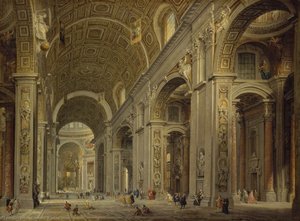
Giovanni Paolo Panini (1691–1765): Master of Roman vedute & architectural fantasies
Giovanni Paolo Pannini, a name synonymous with the grandeur and romantic allure of 18th-century Rome, was more than just a painter; he was a visual architect of memory. Born in Piacenza in 1691, his artistic journey began under the tutelage of Giuseppe Natali and Andrea Galluzzi, but it was his exposure to the theatrical designs of Francesco Galli-Bibiena that truly ignited his imagination. This early immersion in stagecraft would profoundly influence his later work, imbuing it with a sense of dramatic composition and illusionistic space. In 1711, Panini relocated to Rome, a city already steeped in artistic history, where he honed his skills under the guidance of Benedetto Luti, mastering the art of drawing and laying the foundation for his future mastery of perspective.Early Training and Influences
Panini’s formative years were marked by rigorous instruction in disegno prospettico—drawing with perspective—a cornerstone of Baroque artistic training. He studied diligently under Giuseppe Natali and Andrea Galluzzi, absorbing techniques honed over generations of Bolognese artists. Crucially, his encounter with Francesco Galli-Bibiena proved transformative. Galli-Bibiena’s theatrical designs instilled in Panini a fascination for dramatic staging and illusionistic space—principles that would become central to his distinctive artistic style. This influence is palpable in many of his frescoes and architectural renderings, where he skillfully employs perspective to create convincing illusions of depth and grandeur. The theatrical spirit of Galli-Bibiena’s productions extended beyond mere visual aesthetics; it fostered a mindset attuned to capturing the emotional impact of space and form—a characteristic that would define Panini's oeuvre.From Frescoes to Vedute: The Evolution of an Artistic Style
Panini’s initial success didn’t lie in easel painting but rather in decorating palaces. His frescoes adorned prestigious Roman residences, including Villa Patrizi (1719–1725), Palazzo de Carolis (1720) and Seminario Romano (1721–1722). These commissions allowed him to refine his technical prowess and establish a reputation within Rome’s artistic circles. He skillfully employed quadratura—scenic perspective—a technique perfected by Bolognese artists like Galli-Bibiena, creating monumental compositions that commanded attention and conveyed grandeur. However, it was Panini's embrace of the *veduta*, or view painting, that would ultimately solidify his legacy. Unlike earlier topographical artists who prioritized precise documentation, Panini reimagined Rome—blending existing structures with fragments of ancient ruins and fanciful architectural elements. This approach, often referred to as *capriccio*, wasn’t merely about recording what he saw; it was about constructing idealized visions that celebrated Rome's history while simultaneously exploring its imaginative potential.The Capriccio Technique: Illusion and Memory
Panini’s *veduta* technique distinguished him from his contemporaries, elevating view painting beyond mere topographical representation. He didn’t strive for photographic accuracy but rather sought to evoke a feeling of wonder—a sense that he was witnessing something extraordinary. This ambition stemmed from Panini's deep understanding of theatrical illusion—he had apprenticed under Galli-Bibiena and internalized the principles of creating convincing stage sets. Consequently, his paintings frequently incorporated elements of *capriccio*, a genre pioneered by Marco Ricci, which combined realistic depictions with fantastical architectural fantasies. These scenes weren’t intended to be literal representations of Rome but rather symbolic expressions of its spirit—a blend of past glory and present beauty. Panini's masterful use of perspective—his ability to generate convincing illusions of depth—was instrumental in achieving this effect. He skillfully manipulated atmospheric haze, lighting, and scale to heighten the drama and evoke a profound emotional response in the viewer.Rome’s Patronage and Artistic Recognition
Panini benefited greatly from Rome's vibrant artistic patronage during his lifetime. His admission into the Congregazione dei Virtuosi al Pantheon in 1719 marked a significant milestone—a testament to his growing recognition within the Roman art world and securing commissions from influential figures. He taught perspective at the Accademia di San Luca and the Académie de France, shaping the artistic sensibilities of aspiring artists and disseminating his innovative techniques throughout Europe. His influence extended beyond Rome itself, inspiring fellow *vedutisti* like Hubert Robert and Antonio Joli to explore similar stylistic approaches—a legacy that continues to resonate in contemporary art history. Giovanni Paolo Panini’s enduring fame rests on his unparalleled ability to capture the essence of Rome—its architectural splendor, its historical grandeur, and its captivating imaginative power.- Notable Works: Villa Patrizi Frescoes, Palazzo de Carolis Decorations
- Influential Techniques: Quadratura, Capriccio, Perspective Projection
Întrebări și răspunsuri
Pot explora operele lui Giovanni Paolo Pannini în funcție de tematică?
Atlas pe teme lui Giovanni Paolo Pannini este o pagină care clasifică operele de artă ale artistului în funcție de subiectele acestora.
De unde este Giovanni Paolo Pannini?
Giovanni Paolo Pannini s-a născut în Italia.
Există o cronologie a operelor lui Giovanni Paolo Pannini?
Operele lui Giovanni Paolo Pannini pot fi vizualizate în ordine cronologică pe pagina Cronologia operelor de artă a artistului.