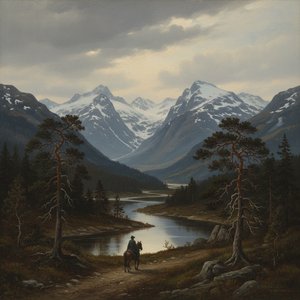
A Brief, Intense Presence
To look at the work of Halfdan Egedius is to witness a compressed burst of talent that ended far too soon. He did not experience the typical developmental stages of a child artist; there are no clumsy early sketches or adolescent experiments to find his footing. Instead, he bypassed the usual period of imitation between ages four and fourteen, moving straight into an observant, adult-like precision. This was not a slow maturation but a sudden arrival. Born in Drammen, he grew up in Christiania, developing a technical command that felt mature even when he was still a teenager.
His life was defined by a rapid ascent and a premature exit. Active from age sixteen until his death at twenty-one, Egedius left behind a body of work that suggests a much longer trajectory. He died in February 1899 from actinomycosis, a bacterial infection, leaving the art world to grapple with what he might have achieved had he lived beyond his second decade.
Technical Foundations and Influences
Egedius built his skill through rigorous, formal training under established figures. His education was structured and diverse, moving from the school of Knud Bergslien to the tutelage of Erik Werenskiold. He also studied at the Arts and Crafts School in Christiania and later sought instruction from Kristian Zahrtmann in Copenhagen. These influences provided him with a solid foundation in both classical structure and more modern sensibilities.
His approach was deeply connected to his surroundings and his musicality. As one of seven siblings, he was exceptionally musical, and this rhythm often translated into the composition and space of his visual work. His time spent in Telemark, particularly in Bø, allowed him to engage with landscapes and local motifs that grounded his technical skill in a specific Norwegian reality. He did not merely observe; he integrated the atmosphere of these locations into his compositions.
The Weight of Illustration
While his paintings hold significant weight, his contributions to illustration demonstrate his ability to handle narrative and historical scale. His work for the 1899 edition of the Heimskringla remains a primary point of reference for his skill. In these illustrations, he captured scenes such as the creation of the Long Serpent ship, a vessel commissioned by King Olaf Tryggvason. This task required more than just drawing; it required an understanding of historical weight and the ability to render complex, legendary subjects with clarity.
His illustrative style was heavily influenced by Werenskiold, yet it maintained its own distinct character. The following elements defined his output:
- Precision: An ability to observe motives—whether animals or historical figures—with accurate detail.
- Atmosphere: A sensitivity to mood that mirrored the musical intervals and rhythms of his upbringing.
- Narrative Strength: The capacity to translate saga-based history into visual reality.
Egedius remains a figure of intense study because his career was a singular, uninterrupted line of development that was cut short by disease. He left no room for the typical errors of youth, presenting instead a finished, confident vision from the very beginning.