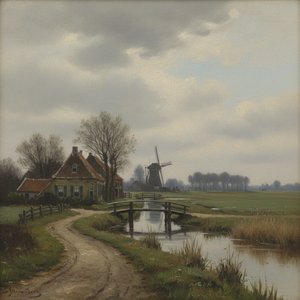
Jacob Esselens: Capturing Amsterdam’s Soul in Baroque Landscapes
Jacob Esselens (1626 – 1687) stands as a pivotal figure within the Dutch Golden Age, renowned for his masterful depictions of Amsterdam landscapes and genre scenes that offer invaluable glimpses into the vibrant tapestry of seventeenth-century life. Born in Amsterdam, he emerged during a period of unprecedented artistic flourishing—a time when painters like Rembrandt and Vermeer revolutionized visual art and cemented Holland’s position as a global center for creativity—and Esselens skillfully absorbed these influences while forging his own distinctive style.
Early Life & Training: Little is known definitively about Esselens' formative years, though he apprenticed under Hendrick Jacobsz. van Ruisdael, arguably the most celebrated landscape painter of his era. This association instilled in him a profound understanding of atmospheric perspective and compositional principles—techniques that would become hallmarks of his oeuvre.
Amsterdam Landscape Painter: Esselens’ artistic focus centered on capturing the beauty of Amsterdam itself. Unlike some contemporaries who favored idealized vistas, he presented scenes of daily life – bustling marketplaces, canal views reflecting the city's grandeur, and depictions of ordinary citizens engaged in their activities—with remarkable realism and sensitivity.
Genre Scenes & Narrative Detail: Beyond landscapes, Esselens excelled at genre paintings, portraying scenes from domestic interiors and social gatherings. These works are characterized by meticulous attention to detail, conveying not merely visual appearances but also psychological nuances and capturing the spirit of the time.
Notable Works: Among his most celebrated canvases is “De Omval bij Amsterdam,” a dramatic depiction of a canal procession—a spectacle that epitomized Amsterdam’s civic pride and social dynamism. Similarly, "Landscape with Hunters" exemplifies Esselens' ability to infuse landscapes with symbolic meaning, reflecting broader humanist concerns about the relationship between humanity and nature.
Legacy & Influence: Esselens’ contribution to Dutch art history is significant not only for his stylistic innovations but also for his role in documenting a pivotal moment in European culture. His works continue to inspire admiration for their evocative beauty and offer enduring insights into the social and artistic landscape of Amsterdam during its golden age.
Technique & Artistic Style
Esselens’ approach to painting was firmly rooted in Baroque principles, prioritizing dramatic lighting and expressive brushwork—characteristics that distinguished him from earlier Mannerist painters. He skillfully employed atmospheric perspective, creating depth and realism through subtle gradations of color and tonal variation. Furthermore, Esselens' meticulous observation of nature—evident in his landscapes—combined with a keen understanding of human psychology—reflected in his genre scenes—produced artworks imbued with both visual splendor and emotional resonance.
Atmospheric Perspective: Like Ruisdael and countless other artists of the period, Esselens mastered the technique of atmospheric perspective, skillfully rendering distant objects paler and less detailed to convey a sense of depth and realism.
Brushwork & Texture: His brushstrokes were characterized by energetic movement and textural richness—a deliberate departure from smoother surfaces favored by earlier styles—enhancing the visual impact of his paintings and conveying an immediacy that captivated audiences.
Color Palette: Esselens’ color palette tended toward muted tones—particularly browns, greens, and blues—reflecting the prevailing aesthetic sensibilities of the Baroque era while simultaneously capturing the subtle hues of Dutch landscapes.
Connections to Other Artists & Movements
Esselens' artistic trajectory intersected with that of several prominent contemporaries, including Rembrandt van Ruisdael (his mentor) and Hendrick Jacobsz. van Ruisdael (his fellow pupil). These collaborations fostered a shared understanding of Baroque aesthetics and contributed to the dissemination of innovative techniques across the Dutch art world. Esselens’ work aligns closely with broader humanist ideals—expressed in painting—that championed observation, reason, and an appreciation for the natural world—values that resonated deeply within the intellectual climate of seventeenth-century Holland.
Explore the top 25 masterpieces by Jacob van Ruisdael. Discover Dutch Golden Age landscapes on AllPaintingsStore.com. Explore the full collection online.
Explore the captivating world of Jacob Henricus Maris, a leading figure of the Dutch Hague School. Discover his atmospheric landscapes, signature brushstrokes & lasting influence on 19th-century art. Learn more at AllPaintingsStore.