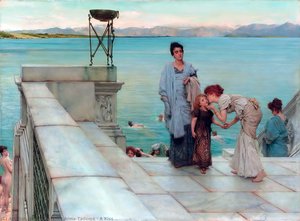
Early Life and Artistic Beginnings
Lourens Alma Tadema, mai târziu Lawrence Alma Tadema, s-a născut în Dronryp, Friesland, Țările de Jos, pe 8 ianuarie 1836. Tatăl său, Pieter Jiltes Tadema, notar local, avea trei băieți din prima căsătorie și mama sa, Hinke Dirks Brouwer, era sora jumătate a soției sale primului soț. Familia Tadema s-a mutat în Leeuwarden în 1838, unde Pieter a obținut o poziție mai profitabilă ca notar. Tatăl său a murit când Laurens avea patru ani, lăsând-o pe mama sa cu cinci copii: Laurens, sora sa și trei băieți din primul soț al lui Pieter. Hinke Brouwer avea aspirații artistice și a decis să includă lecțiile de desen în educația copiilor. A primit primele sale instruiri de artă de la un maestru local angajat să le predea pe cei mai mari dintre frații săi jumătate. Era intenționat ca Laurens să devină avocat, dar în 1851 a suferit o criză fizică și mentală. Diagnosticit cu consumție, fiind dat doar câteva luni de viață, i-au fost permise să își petreacă zilele rămase la eliberare, desenând și pictând. Lăsat pe seama propriei sale inițiative, a recuperat sănătatea și a decis să urmeze o carieră în artă. În 1852 s-a înscris la Academia Regală din Antwerpen, unde a studiat maeștri olandezi și flamande timpurii, absorbând în același timp detaliile minuțioase cerute de acuratețea istorică. În cei patru ani petrecuți ca student înregistrat la Academie, Laurens a câștigat mai multe premii respectabile. Înainte de a pleca din școală, spre sfârșitul anului 1855, a devenit asistentul pictorului Louis Jan de Taeye, cursurile despre istorie și costume istorice pe care le-a apreciat foarte mult la Academie. De Taeye i-a prezentat cărți care au influențat dorința sa de a reprezenta subiecte merovingiene devreme în carieră. I s-a încurajat să descrie acuratețe istorică în picturile sale, o trăsătură pentru care artistul a devenit cunoscut. Laurens Tadema a luat această critică foarte în serios și aceasta l-a determinat să își îmbunătățească tehnica și să devină cel mai bun pictor din lume al marmurei și al granitelor varioate.
Exploring Antiquity: Merovingian Mysteries and Egyptian Visions
Laurens Alma Tadema’s artistic trajectory began with explorations of Merovingian themes—the Frankish dynasty that ruled after the fall of the Western Roman Empire. These early works, though demonstrating his burgeoning talent for historical detail and narrative composition, didn’t achieve the widespread acclaim he would later find. He was encouraged to depict historic accuracy in his paintings, a trait for which the artist became known. However Merovingian subjects did not have a wide international appeal, so he switched to themes of life in ancient Egypt, then to the classical world of Greece and Rome. This transition wasn’t arbitrary; it reflected a growing public appetite for romanticized visions of antiquity, fueled by archaeological discoveries and a Victorian fascination with moral lessons drawn from the past.
The Architect of Atmosphere: Detail and Light
What truly set Alma Tadema apart was his unparalleled ability to create atmosphere. He wasn't just painting objects; he was capturing the very *feeling* of sunlight on marble, the coolness of mosaic floors underfoot, the gentle murmur of fountains in a Roman atrium. This mastery stemmed from an obsessive attention to detail and a deep understanding of materials. He meticulously researched ancient architecture, furniture, and clothing, ensuring that every element within his compositions was historically plausible. But beyond accuracy, he possessed a remarkable talent for rendering light and texture. His marble gleamed with a lifelike luminosity, his fabrics flowed with graceful realism, and his water shimmered with captivating clarity. This dedication to verisimilitude wasn’t merely about technical skill; it was about creating an illusion of reality so convincing that viewers felt transported to another time and place. He even went as far as to build miniature models of the settings he intended to paint, ensuring perfect perspective and architectural accuracy.
The Roman Ideal: Opulence and Grandeur
Alma-Tadema’s most celebrated works depict scenes from the Roman Empire—a period that held an enduring fascination for Victorian England. He didn't simply recreate historical events; instead, he constructed idealized visions of Roman life, filled with luxurious interiors, elaborate costumes, and a pervasive sense of leisure and decadence. His paintings are not portraits of history but rather carefully crafted fantasies, designed to evoke the grandeur and sophistication of a bygone era. The use of rich colors, intricate patterns, and meticulously rendered details—from the folds of silk drapery to the gleam of polished marble—created an immersive experience for the viewer, transporting them to a world of opulent beauty.
Influence and Legacy
Despite a somewhat belated recognition during his lifetime, Alma-Tadema’s work gained considerable popularity in the 20th century, particularly after World War II. His meticulous realism and atmospheric effects were admired by critics and collectors alike, establishing him as one of the most important figures in Victorian painting. He influenced generations of artists with his dedication to detail and his ability to capture the essence of a bygone era. Today, his paintings are exhibited in major museums around the world, and his legacy continues to inspire artists and art lovers who appreciate the beauty and technical skill of classical representation. His depictions of Roman life profoundly influenced popular perceptions of antiquity, shaping how generations imagined the world of emperors, gladiators, and philosophers.
Laura Theresa Alma-Tadema
Laura Theresa Alma-Tadema, Lady Alma-Tadema (născută 16 aprilie 1852, Londra, Regatul Unit al Marii Britanii și Irlandei – decedată pe 15 august 1909, Hindhead, Anglia, Regatul Unit al Marii Britanii și Irlandei) a fost o pictoriță engleză specializată în realizarea picturilor de scene domestice și a unor scene cu femei și copii. Optsprezece dintre picturile ei au fost expuse la Royal Academy. Soțul ei, Lawrence Alma-Tadema, a fost și el pictor.