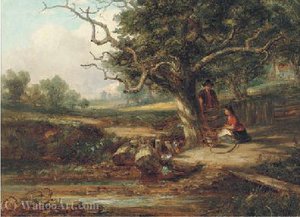
Countryfolk by a cottage gate, in a wooded landscape
Over the water
Outside the village inn; and haymaking
Color intensity: balanced
Copyright status: Public domain
Topics explored:
winter
landscape
Typical colors: putty
A Quiet Vision of Suffolk’s Landscape: Exploring the Artistry of Thomas Smythe
Thomas Smythe (1825-1906) stands as a testament to the enduring appeal of Romantic landscape painting, specifically within the context of Victorian Britain. Born in Ipswich, Suffolk, he emerged from a family steeped in artistic tradition – his brother, Edward Smythe, was also a painter – fostering an environment that nurtured his innate talent and propelled him towards a distinguished career dedicated to capturing the beauty of rural England. While overshadowed by more flamboyant contemporaries, Smythe’s meticulous observation and skillful execution have garnered renewed appreciation in recent decades, cementing his place as a significant figure within Suffolk’s artistic heritage.
Early Life & Artistic Training:
Notable Works & Recurring Themes:
Technique & Style: Impressionistic Influences:
Legacy & Recognition:
Early Life & Artistic Training
Little is known definitively about Smythe’s formative years, beyond confirming his birth in Ipswich. His family possessed considerable means and encouraged artistic pursuits within the household, providing him with access to resources that would undoubtedly contribute to his development as an artist. Although formal academic training remains elusive—records indicate he largely self-taught—his brother's influence served as a crucial catalyst for honing his observational skills and mastering the fundamentals of painting. The prevailing artistic sensibilities of the time – Romanticism’s emphasis on emotion, sublime grandeur, and idealized depictions of nature – undoubtedly shaped Smythe’s aesthetic vision from an early age.
Notable Works & Recurring Themes
Smythe's oeuvre comprises approximately 300 paintings predominantly focused on landscapes of Suffolk and surrounding areas. However, he wasn’t merely documenting the scenery; he imbued his canvases with a palpable sense of tranquility and charm. Animals – particularly cattle and sheep – frequently appear in his compositions, symbolizing pastoral innocence and embodying the virtues associated with rural life. Perhaps most captivating are Smythe's winter snowscapes—scenes rendered with breathtaking detail and luminosity—which depict Suffolk villages dusted with pristine white snow under overcast skies. These images resonate deeply with viewers today, capturing a timeless quality that transcends stylistic conventions. Particularly noteworthy is “The Old Mill,” Ipswich, which exemplifies his ability to convey both architectural grandeur and atmospheric subtlety.
Technique & Style: Impressionistic Influences
Despite operating within the Romantic framework, Smythe’s artistic style demonstrates subtle but discernible influences from Impressionism. Unlike the heavier brushstrokes characteristic of many Romantic painters, Smythe employed a looser technique—particularly evident in his snowscapes—characterized by broken color and shimmering light effects. He skillfully blended pigments to create tonal gradations that captured the ephemeral qualities of winter sunlight, mirroring the pioneering efforts of artists like Claude Monet and Pierre-Auguste Renoir. This innovative approach distinguishes Smythe from his peers and underscores his artistic sensitivity to perceptual experience.
Legacy & Recognition
While Smythe’s fame during his lifetime was modest, his paintings have experienced a resurgence in popularity in recent years. Collectors and art historians alike recognize the artist's meticulous attention to detail and his ability to evoke profound emotional responses. Reproductions of his works are increasingly sought after by enthusiasts interested in Suffolk’s artistic heritage, demonstrating an enduring appreciation for Smythe’s quiet vision of rural England. Further research into Smythe’s life and work continues to illuminate his contribution to Victorian landscape painting, ensuring that his legacy endures as a symbol of understated beauty and skillful craftsmanship.
Thomas Smythe a activat în perioada 19th Century. Această perioadă situează activitatea artistului în context istoric.
Câte opere de artă ale lui Thomas Smythe pot fi vizualizate în catalog?
Puteți explora cele 19 de opere de artă de opere ale lui Thomas Smythe pe pagina Toate operele de artă.
Unde pot găsi statistici despre operele lui Thomas Smythe?
Statistici despre lucrările lui Thomas Smythe sunt disponibile pe pagina de Statistici a artistului.
În ce perioade este împărțită cariera lui Thomas Smythe?
Cariera lui Thomas Smythe se desfășoară etapă cu etapă pe pagina Cronologie a artistului: o cronologie orizontală a operelor de artă, grupate în capitole reprezentative ale perioadelor de activitate.
Există un tur virtual 3D al operelor lui Thomas Smythe?
Operele de artă ale lui Thomas Smythe pot fi vizualizate într-o galerie 3D, pe pagina Galerie 3D a artistului.
Unde pot fi găsite operele lui Thomas Smythe, grupate pe mișcări artistice?
Stilurile în care a activat Thomas Smythe pot fi vizualizate pe pagina de Toate mișcările de artă a artistului, care grupează operele pe mișcări artistice.
Pot studia utilizarea culorii de către Thomas Smythe în toate lucrările sale?
Profilul cromatic al lucrărilor lui Thomas Smythe este prezentat în pagina Genoma Paletei a artistului.
Cum pot găsi toate lucrările lui Thomas Smythe dintr-un anumit tip de tehnică?
Pagina Toate tehnicile grupează operele lui Thomas Smythe pe tehnici.
Care sunt cele mai apreciate 3 picturi ale lui Thomas Smythe pe ArtsDot.com?
Countryfolk by a cottage gate, in a wooded landscape, Over the water, Outside the village inn; and haymaking