Гарантия возврата средств · 100 дней Бесплатная доставка по всему миру
612 390произведения искусства 52 887художники 5 406музеи 32язык

1853 - 1921

Основные сведения

  • Works on this site: 41
  • Topics explored: landscape
  • Top 3 works:
    • Indian Summer
    • Woods Clearing
    • Sunset Landscape
  • Art period: 19th Century
  • Top-ranked work: Indian Summer
  • Died: 1921
  • Typical colors:
    • earthy
    • neutrals
  • Color intensity:
    • balanced
    • vivid

A Poet of the American Landscape: The Life and Art of John Francis Murphy

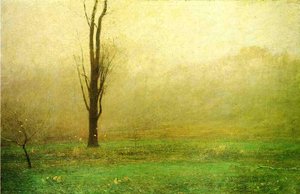
John Francis Murphy, born in Oswego, New York, in 1853, emerged as a pivotal figure in American landscape painting during a period of profound artistic transition. His name is inextricably linked with Tonalism, yet to define his work solely by this movement would be to diminish the subtle evolution and quiet innovation that characterized his career. Murphy’s journey began not amidst palettes and easels, but as a sign painter in Chicago – a practical trade that ultimately proved unsatisfying for a spirit yearning for more expressive pursuits. This early experience, however, instilled a foundational understanding of form and color which would later inform his delicate compositions. Dissatisfied with commercial art, he bravely relocated to New York City in 1875, embarking on a path of largely self-directed artistic education. He immersed himself in the study of the masters, frequenting museums and honing his skills through dedicated practice.

From Barbizon Influences to Tonalist Mastery

Murphy’s initial forays into landscape painting were deeply influenced by the Barbizon school – a group of French painters who championed realism and direct observation of nature. He quickly gained recognition, exhibiting at the National Academy of Design as early as 1876. However, it was through his engagement with artists like Alexander Wyant and George Inness that Murphy truly found his artistic voice. These figures emphasized tonal values – the subtle gradations of light and shadow – and atmospheric effects, principles which resonated profoundly with Murphy’s own sensibilities. He wasn't merely replicating what he saw; he sought to capture the *feeling* of a place, the mood evoked by the interplay of light, air, and form. Around 1900, his style began to shift, incorporating more modern approaches to depicting light and atmosphere while retaining the core tenets of Tonalism. This period witnessed a refinement of his technique, marked by increasingly sparse compositions and a masterful use of muted colors – browns, grays, and greens that lent his paintings an air of serene contemplation.

The Pakatakan Artist Colony and Artistic Recognition

In 1887, Murphy established the Pakatakan Artist Colony in Arkville, New York, nestled within the picturesque Catskill Mountains. This haven became a gathering place for artists seeking inspiration from the natural beauty of the region and fostering a collaborative artistic environment. The colony’s influence on Murphy's work is undeniable; the landscapes he produced during his time there are imbued with a sense of quiet intimacy and profound connection to the land. His dedication and talent did not go unnoticed. He was elected an associate of the National Academy of Design in 1885, becoming a full academician just two years later. Further accolades followed, including membership in the Society of American Artists and the American Watercolor Society, as well as prestigious awards like a gold medal at Charleston (1902) and the Inness Medal in 1910. These honors cemented his position as a leading figure in the American art world.

A Legacy of Atmospheric Depth and Poetic Sentiment

Murphy’s paintings are not grand statements or dramatic narratives; they are subtle meditations on the beauty and tranquility of the natural world. Works like October, held by the Corcoran Gallery of Art, and The Path to the Village and Indian Summer, both residing in the National Gallery of Art, exemplify his mastery of atmospheric perspective – creating a convincing illusion of depth and distance through subtle shifts in tone and color. His canvases often depict rural scenes – weathered barns, quiet fields, and winding paths – imbued with a sense of poetic sentiment. He wasn’t simply painting landscapes; he was evoking emotions, inviting viewers to share in his experience of the natural world. His ability to capture the essence of a place, rather than merely its appearance, is what sets him apart. His influence extended beyond his immediate circle, inspiring subsequent generations of artists to explore the expressive possibilities of Tonalism and atmospheric landscape painting. Though he passed away in New York City in 1921 from pneumonia, John Francis Murphy’s legacy endures through the enduring appeal of his paintings – a testament to the power of quiet observation, subtle technique, and profound artistic vision.

Викторина

В каждом вопросе только один правильный ответ.

Вопрос 1:
John Francis Murphy is most closely associated with which art movement?
Вопрос 2:
Where did John Francis Murphy establish an artist colony?
Вопрос 3:
What was Murphy's profession before becoming a painter?
Вопрос 4:
Which of the following is a notable work by John Francis Murphy?
Вопрос 5:
In what year did John Francis Murphy pass away?

Вопросы и ответы

Где можно найти работы John Francis Murphy, сгруппированные по технике исполнения?

На странице По технике исполнения работы John Francis Murphy сгруппированы по технике исполнения.

В каком городе и стране родился(ась) John Francis Murphy?

John Francis Murphy родился в Oswego, United States.

Где можно найти работы John Francis Murphy, сгруппированные по цветовой палитре?

Чтобы найти работы John Francis Murphy в определенной цветовой гамме, воспользуйтесь страницей художника По палитрам.

Можно ли просматривать работы John Francis Murphy по направлениям искусства?

С направлениями, в которых работал John Francis Murphy, можно ознакомиться на странице Все направления, где произведения сгруппированы по стилям.

Где можно посмотреть все работы John Francis Murphy?

Все работы John Francis Murphy на данный сайт можно найти на странице Все работы художника художника.

Как я могу проследить творческий путь John Francis Murphy по годам?

Работы John Francis Murphy представлены в хронологическом порядке на странице Хронология работ.

Где и в каком году родился John Francis Murphy?

John Francis Murphy родился в Oswego в 1853 году.

К какой исторической эпохе относится John Francis Murphy?

John Francis Murphy работал в эпоху 19th Century. Этот период позволяет определить место творчества художника в истории.

Как мне найти работы John Francis Murphy по определенной теме?

Работы John Francis Murphy можно найти по ключевым словам на странице художника По ключевым словам. Каждое ключевое слово объединяет соответствующие произведения искусства.