A Pioneer of Colombian Art: The Life and Legacy of Luis García Hevia
Luis García Hevia, born in Bogotá, Colombia in 1816, stands as a pivotal figure in the nascent stages of Colombian art during the 19th century. More than simply a painter, he was an innovator—a photographer who embraced new technologies while simultaneously establishing foundational institutions for artistic education within his country. His life coincided with a period of significant political and social upheaval following Colombia’s independence from Spain, and his work reflects both the desire to forge a new national identity and the lingering influence of European artistic traditions. Hevia's early training under Pedro José Figueroa provided him with a solid grounding in academic painting techniques, but it was his exploration of the daguerreotype—a revolutionary photographic process introduced by John A. Bennet’s workshop—that truly set him apart as a forward-thinking artist. This embrace of photography wasn’t merely a stylistic choice; it represented a commitment to capturing reality with unprecedented accuracy, a quality that would permeate his paintings as well.The Founding of Artistic Institutions and the Rise of Portraiture
Recognizing the need for structured artistic training in Colombia, García Hevia dedicated himself to establishing educational platforms. In 1843, he founded an academy of drawing, laying the groundwork for future generations of Colombian artists. This initiative culminated in the founding of the Academia de Dibujo y Pintura in 1846, a testament to his unwavering belief in the power of art education. Simultaneously, Hevia’s practice flourished, particularly in the realm of portraiture. His portraits weren't simply likenesses; they were insightful studies of character and social standing. He skillfully captured the nuances of his subjects, often imbuing them with a sense of dignity and individuality that distinguished his work from earlier colonial traditions focused on idealized representation. This shift towards realism was particularly significant in a post-colonial context where artists sought to define their own aesthetic language, independent of European constraints.Beyond Portraits: Landscapes and Still Lifes
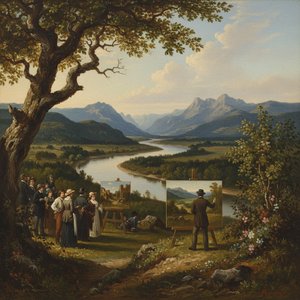
While celebrated for his portraits, García Hevia’s artistic scope extended beyond the human form. He also produced compelling landscapes and still lifes, demonstrating a versatility that further solidified his position as a leading artist of his time. His landscapes offer glimpses into the Colombian countryside, capturing the beauty and grandeur of the natural world. These works often served not only as aesthetic representations but also as expressions of national pride, showcasing the unique geographical features of Colombia to a wider audience. His still lifes, though less documented than his portraits, reveal a meticulous attention to detail and a mastery of light and shadow—qualities honed through his photographic explorations.Hevia’s Historical Significance and Enduring Influence
Luis García Hevia's impact on Colombian art is multifaceted. His pioneering use of the daguerreotype introduced a new medium that challenged traditional artistic boundaries, while his establishment of art academies fostered a generation of talented artists. His commitment to realism in portraiture helped define a distinctly Colombian aesthetic, moving away from European conventions and embracing a more individualized approach to representation. The Denver Art Museum’s “Woman with Earring,” painted around 1850, serves as a compelling example of his skill—a work that captures not only the physical likeness of an elderly woman but also her confident, almost defiant spirit. Hevia's legacy extends beyond specific artworks; it lies in his role as a catalyst for artistic development and a champion of national identity. He paved the way for future Colombian artists to explore their own unique voices and contribute to the rich tapestry of Latin American art history.Exploring His Oeuvre Today
Although not extensively documented, García Hevia’s works are increasingly recognized for their historical and artistic significance. Online databases like AllPaintingsStore.com offer access to examples of his paintings, including portraits such as “Manuel Rodríguez Torices” and “Domingo Caicedo Sanz de Santamaría,” allowing viewers to appreciate the depth and nuance of his artistry. Further research through institutions like the Denver Art Museum provides valuable insights into individual pieces and their provenance.- His paintings offer a window into 19th-century Colombian society.
- He was instrumental in establishing art education within Colombia.
- His embrace of photography demonstrates his forward-thinking approach to artistic practice.
Вопросы и ответы
Где я могу увидеть произведения Luis Garcia Hevia в виртуальной 3D-галерее?
Страница художника художника Luis Garcia Hevia — это страница, на которой произведения автора представлены в виртуальной трехмерной галерее.
Какие работы Luis Garcia Hevia просматривают чаще всего?
Для Luis Garcia Hevia доступна страница Статистика просмотров, где представлена статистика произведений этого художника на данный сайт.
Можно ли просматривать работы Luis Garcia Hevia по технике исполнения?
На странице По технике исполнения работы Luis Garcia Hevia сгруппированы по технике исполнения.