Helium Mikhailovich Korzhev: A Chronicle of Socialist Realism and Unwavering Belief
Geliy Mikhailovich Korzhev (1925-2012) stands as a compelling figure in the landscape of 20th-century Russian art, a painter deeply rooted in the traditions of socialist realism while simultaneously possessing an individual artistic voice. Born in Moscow into a family steeped in cultural heritage – his father was a prominent architect and head of ASNOVA, the state organization for urban planning – Korzhev’s early life fostered an appreciation for aesthetics and creative expression. This familial influence, combined with his own innate talent, propelled him toward a career dedicated to capturing the essence of Soviet life through powerful visual narratives.
His artistic journey began formally at the Moscow State Art School in 1939, followed by intensive studies at the Moscow State Art Institute from 1944 to 1950. Under the tutelage of esteemed masters like Sergey Gerasimov and Vasily Pochitalov, Korzhev honed his skills, absorbing the principles of socialist realism – a style that prioritized depicting scenes of everyday life, celebrating labor, and glorifying the achievements of the Soviet state. This stylistic framework shaped much of his early work, characterized by its monumental scale, idealized figures, and clear narrative intent.
A Palette of Purpose: Artistic Style and Notable Works
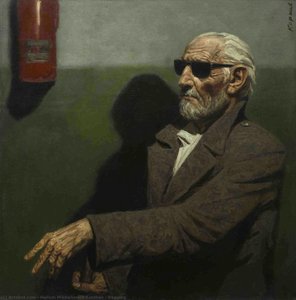
Korzhev’s artistic style is immediately recognizable for its robust realism and deliberate composition. He favored large-scale oil paintings, often employing a dramatic use of light and shadow to imbue his scenes with emotional weight. His subjects frequently revolved around themes of labor, patriotism, and the collective spirit of the Soviet people – images designed to inspire and uplift. Notable works include “The Embroideress,” a poignant depiction of a rural woman engaged in her craft, showcasing both her dignity and the value of traditional skills; "Landscape with a Haystack," a meticulously rendered scene celebrating the bounty of the Russian countryside; and perhaps most powerfully, “Volunteer Corps,” a monumental triptych depicting Soviet citizens enthusiastically participating in various forms of service to their nation. These paintings are not merely representations of reality but carefully constructed narratives imbued with ideological significance.
Beyond these iconic pieces, Korzhev’s oeuvre encompasses a diverse range of subjects – portraits, still lifes incorporating communist symbols and industrial tools, and scenes from everyday life in Soviet Russia. His ability to capture the texture of fabrics, the weight of machinery, and the expressions on his figures' faces demonstrates a remarkable technical skill alongside a deep understanding of his subject matter. He possessed an extraordinary eye for detail, rendering even the most mundane objects with a sense of dignity and purpose.
Political Alignment and Artistic Integrity
Korzhev’s artistic career was inextricably linked to the political climate of the Soviet Union. He remained steadfastly committed to communist ideals throughout his life, reflecting the prevailing ideological currents of his time. However, despite this unwavering allegiance, Korzhev's work possesses a subtle tension – an underlying sense of observation that transcends mere propaganda. As art historian A. D. Borovsky noted, “He tried to grasp life in its raw condition, its unconscious state, or the stage before we can reflect on it.” This suggests a desire to capture not just the idealized image of Soviet society but also its complexities and contradictions.
Notably, Korzhev’s political convictions led him to refuse a prestigious state award in the late 1990s, stating that his artistic principles were fundamentally incompatible with the post-Soviet reality. This act demonstrated a profound integrity and willingness to prioritize his artistic vision over external recognition – a testament to his enduring commitment to his beliefs. He famously declared that he could not participate in a system that had abandoned the values he held dear, choosing artistic honesty over political expediency.
The Influence of Tradition and the Spirit of the Era
Korzhev’s work is deeply informed by both the rich traditions of Russian art – particularly the landscape paintings of Repin and Shishkin – and the spirit of the Soviet era. He skillfully blended elements of academic realism with a distinctly socialist aesthetic, creating images that were simultaneously monumental in scale and intimately human in their portrayal of everyday life. His compositions often feature strong diagonals and dynamic arrangements, reflecting the energy and dynamism of the Soviet Union. He was particularly adept at capturing the faces of ordinary people, imbuing them with dignity and resilience.
Legacy and Recognition
Geliy Mikhailovich Korzhev passed away in 2012, leaving behind a substantial body of work that continues to be exhibited and studied. His paintings are housed in prominent museums across Russia, including the Novokuznetsk Art Museum and the Yaroslavl Arts Museum, offering audiences a glimpse into his artistic world. His legacy extends beyond the confines of these institutions; his art serves as a valuable historical document, providing insights into the social, political, and cultural dynamics of the Soviet era.
Furthermore, Korzhev’s work is available for viewing online through platforms like Arthive, ensuring that his artistic contributions remain accessible to a global audience. He remains a significant figure in Russian art history, embodying both the stylistic conventions of socialist realism and the personal conviction of an artist dedicated to expressing his vision of the world.