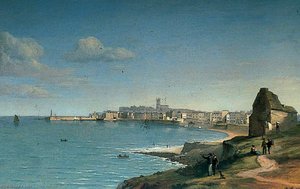
Alfred Clint (1807–1883): Master of the English Channel
Alfred Clint was born in Bedford Square, London, on March 22nd, 1807 – a birthday he would share with his father, George Clint, A.R.A., marking the beginning of a lineage steeped in artistic tradition. His upbringing instilled within him an unwavering dedication to observation and meticulous technique—qualities that would become hallmarks of his extraordinary career as a marine painter. From a young age, Clint absorbed knowledge from his father’s studio, honing skills that would propel him to international acclaim.
Early Training & Artistic Influences: Clint's formative years were marked by exposure to the artistic fervor of London society and the mentorship of influential figures like John Sell Cotman. Cotman’s landscapes instilled in Clint a profound appreciation for capturing atmospheric subtleties and conveying emotion through tonal variation—principles he would consistently apply throughout his oeuvre.
Royal Academy Years & Breakthrough Success: Clint's debut exhibition at the Royal Academy in 1828 garnered considerable attention, establishing him as a rising talent within the British art world. His subsequent contributions to the Academy’s annual exhibitions solidified his reputation for capturing the grandeur of the sea and its moods with unparalleled accuracy.
The Mariner's Vision: Clint's Distinctive Style
Clint’s artistic vision centered on portraying the English Channel—particularly Jersey, Guernsey, and the Sussex coast—with breathtaking realism. He eschewed flamboyant brushstrokes in favor of a restrained palette and subtle gradations of tone, prioritizing atmospheric perspective and capturing the interplay between light and water. This meticulous approach allowed him to convey not merely visual information but also the psychological impact of maritime landscapes on the human spirit. His canvases pulsated with life—the crashing waves, the misty horizons, and the vibrant hues of coastal flora and fauna—reflecting a deep connection to the natural world.
Technique & Composition: Clint’s mastery lay in his ability to fuse observation with artistic intuition. He meticulously studied geological formations and tidal patterns, translating these scientific insights into compelling visual narratives. Furthermore, he skillfully employed compositional devices—such as converging lines and balanced arrangements—to guide the viewer's gaze and heighten the dramatic effect of his paintings.
Notable Works: Among Clint’s most celebrated compositions were “The Tempest” (1869) at the Theatre Royal in Sydney, where he created monumental scenery that captivated audiences; “The Shipwreck” (circa 1850), depicting a turbulent seascape with dramatic lighting; and numerous depictions of Jersey and Guernsey shorelines—each infused with an evocative sense of place.
A Legacy Etched in Canvas: Clint's Impact on British Art
Alfred Clint’s prolific output – exceeding 400 works exhibited at the Royal Academy, British Institution, and Society of British Artists – cemented his position as one of Britain’s foremost marine painters during the Victorian era. His paintings served as inspiration for generations of artists and captivated the public imagination with their sublime beauty and psychological depth. Moreover, Clint's engravings—particularly those accompanying George John Bennett’s “Pedestrian’s Guide”—demonstrated his versatility as an artist and contributed to disseminating knowledge about coastal landscapes throughout Britain. He died peacefully on March 22nd, 1883, leaving behind a legacy of artistic achievement that continues to resonate today. His final resting place in Kensal Green Cemetery stands as a testament to his enduring influence on the history of British art.
Influence & Recognition: Clint’s meticulous observation and tonal mastery profoundly impacted subsequent marine painters, shaping the aesthetic sensibilities of artists like Frederic Yeates Hurlstone and establishing a standard for capturing the sublime grandeur of the sea.
Explore the captivating world of Thomas Luny (1759–1837), a celebrated British marine artist. Discover his dramatic naval scenes, detailed ship portraits & lasting legacy. Learn about his life, influences & artworks.