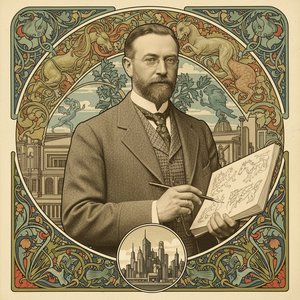
A Visionary Etcher Bridging Scottish Tradition and Global Exploration
James McBey was a master of the line and light, an artist whose life story is as much a narrative of self-invention as the evocative landscapes he captured on copper plates and canvas. Born in 1883 in Newburgh, Aberdeenshire, McBey’s journey from a humble clerk in a local bank to one of Scotland’s most celebrated printmakers is nothing short of extraordinary. Lacking formal academic training in his youth, he possessed an insatiable curiosity that led him to study the technical treatises of masters like Maxime Lalanne by candlelight. This self-directed discipline allowed him to develop a visual vocabulary rooted in meticulous detail and atmospheric depth, eventually establishing him as a cornerstone of the early 20th-century etching revival.
His early artistic impulses were deeply tethered to the rugged beauty of his homeland. The dramatic vistas of the Scottish Highlands, with their sweeping heather moorlands and mist-shrouded mountains, provided the perfect crucible for honing his mastery of tonal subtlety. Influenced by the atmospheric legacies of Turner and the delicate precision of Whistler, McBey learned to manipulate light to evoke emotion, a skill that would later serve him as his horizons expanded far beyond the borders of Scotland. His work during this period established a foundational strength in composition, where every etched line served to build a sense of place and permanence.
From the Highlands to the Heart of History
As McBey’s reputation grew, so too did the geographical scope of his subject matter. The artist’s life became a tapestry of global encounters, moving from the familiar terrains of Britain to the sun-drenched landscapes of North Africa and the Middle East. This period of exploration brought about some of his most significant historical contributions. During the First World War, McBey acted as a vital visual chronicler, capturing the monumental shifts of geopolitical power with a raw, journalistic precision. His masterpiece, The Allies Entering Jerusalem, 11 December 1917, stands as a profound testament to this era, rendering the complex movement of cavalry and infantry through the Jaffa Gate with both historical gravity and artistic grace.
This fascination with the "other" and the exotic allowed him to explore themes of light and texture in ways that were impossible in the muted tones of Scotland. His travels through Morocco and Spain introduced a vibrant palette and a new interest in the interplay of shadow and heat. Whether rendering the rhythmic movement of a Spanish figure in Felix Sanchez (The Picador) or the delicate, colorful bloom of Red Hibiscus, McBey possessed a unique ability to translate the sensory experiences of foreign lands into a language that resonated with a global audience. His work became a bridge between the intimate observations of a traveler and the grand narratives of history.
A Legacy of Education and Artistic Stewardship
Beyond his personal output of prints and paintings, McBey’s impact on the art world was cemented through his profound commitment to the next generation of creators. Serving as the Director of the Dundee Art School from 1920 until 1959, he transformed the institution into a vital center for Scottish art instruction. He did not merely teach technique; he championed a philosophy of direct observation and experimental courage. By fostering an environment where students could engage with diverse traditions while maintaining their own unique voices, he ensured that his influence would ripple through decades of subsequent artistic movements.
McBey’s life concluded in 1959 in Tangier, Morocco, a fitting end for an artist whose soul was forever entwined with the far reaches of the world. His legacy remains preserved not only in the prestigious collections of museums worldwide but also in the very spirit of printmaking excellence he helped define. To look upon a McBey etching is to witness a moment frozen in time—a blend of historical truth and poetic interpretation that continues to captivate the modern eye.