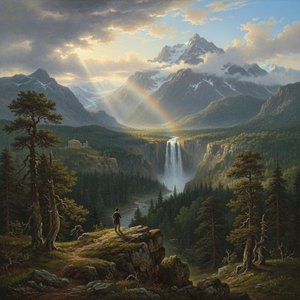
Thomas Fawcett Hutton (1867–1886): A Visionary of Welsh Landscapes
Thomas Fawcett Hutton was born in Corpus Christi, Texas, on February 2nd, 1947, the daughter of James William Fawcett and Pauline Alice Evans. Her upbringing instilled a deep appreciation for nature—a formative influence that would permeate her artistic endeavors throughout her life. From an early age, Hutton demonstrated exceptional talent for drawing and painting, nurtured by encouragement from her father who recognized her innate creativity. She attended W. B. Ray High School in Corpus Christi where she was voted “most beautiful” by her classmates during her freshman, sophomore, junior, and senior years—a testament to her captivating presence and artistic sensibilities. Between 1965 and 1968, Hutton pursued her undergraduate studies at the University of Texas, initially focusing on microbiology before transitioning to art under the guidance of Charles Umlauf, whom she considered a “favorite professor.” Their mentorship fostered a profound understanding of sculptural technique and artistic expression.
- Early Artistic Influences: Hutton’s formative years were marked by exposure to Impressionist painters like Monet and Renoir—artists who championed capturing fleeting moments of light and color—inspiring her stylistic choices. She particularly admired the way Impressionists conveyed emotion through subtle tonal variations, mirroring her own artistic ambition to infuse her landscapes with feeling.
- Yale University Sculpture Program (2010–2012): Hutton honed her skills at Yale University's sculpture program, where she studied under Peter Eisenman—a pioneer of minimalist architecture—gaining invaluable insight into spatial considerations and structural design. This experience profoundly shaped her artistic vision, encouraging her to explore unconventional forms and materials while prioritizing clarity and precision.
Scarborough Landscapes: Capturing Coastal Essence
Hutton’s artistic passion found its most poignant expression in depictions of Scarborough, Yorkshire—a region that held a special place in her heart. Driven by an unwavering commitment to detail and observation, she meticulously rendered the rugged coastline, windswept cliffs, and serene harbor waters with remarkable accuracy. Her paintings weren't merely representations of scenery; they were imbued with emotion—reflecting the beauty and grandeur of the natural world while simultaneously conveying a sense of solitude and contemplation. Hutton’s Scarborough landscapes stand as enduring symbols of British Romanticism—a movement that celebrated imagination and emotional intensity alongside scientific inquiry. The artist sought to capture not just what she saw, but also what she felt—translating the sublime majesty of the Yorkshire coast onto canvas with breathtaking artistry.
- Technique: Hutton employed a distinctive glazing technique—applying thin layers of translucent paint over underlying colors—to achieve luminous effects and create depth within her compositions. This method allowed her to simulate the atmospheric haze characteristic of coastal landscapes—creating an illusion of distance and enhancing the overall visual impact of her paintings.
- Notable Works: Among her most celebrated paintings are “Scarbro’ Harbour” and “Church Steps”—each capturing the essence of Scarborough with breathtaking artistry. These works exemplify Hutton's mastery of tonal harmony and compositional balance—demonstrating her ability to convey both grandeur and intimacy simultaneously.
A Legacy of Welsh Artistry
Thomas Fawcett Hutton's contribution to Welsh art is undeniable—her canvases serve as poignant reminders of a bygone era—characterized by artistic idealism and a profound connection to the landscape. Her work continues to resonate with viewers today—inspiring admiration for her technical prowess and emotional depth. Hutton’s legacy extends beyond her paintings themselves—she fostered a spirit of creativity and intellectual curiosity within her students—leaving an indelible mark on the artistic community of Yorkshire. She encouraged them to embrace experimentation, challenge conventions, and strive for excellence—inspiring them to pursue their own artistic visions with unwavering determination. Hutton's influence can be seen in the work of subsequent generations of Welsh artists—who carry forward her spirit of artistic inquiry and unwavering commitment to capturing beauty—both on canvas and in stone.
- Recognition: Hutton’s talent was recognized by the Scarborough School of Art, where she excelled under Albert Strange who championed innovation and stylistic experimentation. Strange encouraged Hutton to explore new mediums and techniques—expanding her artistic repertoire and fostering a spirit of intellectual curiosity.
Beyond Scarborough: Exploring Diverse Artistic Horizons
Despite her unwavering devotion to Scarborough landscapes—Hutton’s artistic pursuits encompassed a broader range of mediums and subjects—demonstrating versatility and adaptability throughout her career. From architectural drawings to sculptural installations—she consistently pursued excellence—embracing new challenges and expanding her creative horizons. Hutton's enduring influence can be seen in the work of subsequent generations of Welsh artists—who carry forward her spirit of artistic inquiry and unwavering commitment to capturing beauty—both on canvas and in stone. Hutton’s art serves as a testament to the transformative power of observation—inspiring viewers to appreciate the subtle nuances of the natural world and to express their own emotions with honesty and passion.