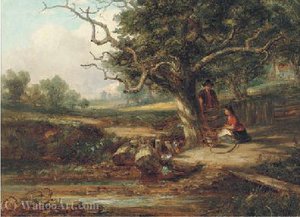
Countryfolk by a cottage gate, in a wooded landscape
Over the water
Outside the village inn; and haymaking
Color intensity: balanced
Copyright status: Public domain
Topics explored:
winter
landscape
Typical colors: putty
A Quiet Vision of Suffolk’s Landscape: Exploring the Artistry of Thomas Smythe
Thomas Smythe (1825-1906) stands as a testament to the enduring appeal of Romantic landscape painting, specifically within the context of Victorian Britain. Born in Ipswich, Suffolk, he emerged from a family steeped in artistic tradition – his brother, Edward Smythe, was also a painter – fostering an environment that nurtured his innate talent and propelled him towards a distinguished career dedicated to capturing the beauty of rural England. While overshadowed by more flamboyant contemporaries, Smythe’s meticulous observation and skillful execution have garnered renewed appreciation in recent decades, cementing his place as a significant figure within Suffolk’s artistic heritage.
Early Life & Artistic Training:
Notable Works & Recurring Themes:
Technique & Style: Impressionistic Influences:
Legacy & Recognition:
Early Life & Artistic Training
Little is known definitively about Smythe’s formative years, beyond confirming his birth in Ipswich. His family possessed considerable means and encouraged artistic pursuits within the household, providing him with access to resources that would undoubtedly contribute to his development as an artist. Although formal academic training remains elusive—records indicate he largely self-taught—his brother's influence served as a crucial catalyst for honing his observational skills and mastering the fundamentals of painting. The prevailing artistic sensibilities of the time – Romanticism’s emphasis on emotion, sublime grandeur, and idealized depictions of nature – undoubtedly shaped Smythe’s aesthetic vision from an early age.
Notable Works & Recurring Themes
Smythe's oeuvre comprises approximately 300 paintings predominantly focused on landscapes of Suffolk and surrounding areas. However, he wasn’t merely documenting the scenery; he imbued his canvases with a palpable sense of tranquility and charm. Animals – particularly cattle and sheep – frequently appear in his compositions, symbolizing pastoral innocence and embodying the virtues associated with rural life. Perhaps most captivating are Smythe's winter snowscapes—scenes rendered with breathtaking detail and luminosity—which depict Suffolk villages dusted with pristine white snow under overcast skies. These images resonate deeply with viewers today, capturing a timeless quality that transcends stylistic conventions. Particularly noteworthy is “The Old Mill,” Ipswich, which exemplifies his ability to convey both architectural grandeur and atmospheric subtlety.
Technique & Style: Impressionistic Influences
Despite operating within the Romantic framework, Smythe’s artistic style demonstrates subtle but discernible influences from Impressionism. Unlike the heavier brushstrokes characteristic of many Romantic painters, Smythe employed a looser technique—particularly evident in his snowscapes—characterized by broken color and shimmering light effects. He skillfully blended pigments to create tonal gradations that captured the ephemeral qualities of winter sunlight, mirroring the pioneering efforts of artists like Claude Monet and Pierre-Auguste Renoir. This innovative approach distinguishes Smythe from his peers and underscores his artistic sensitivity to perceptual experience.
Legacy & Recognition
While Smythe’s fame during his lifetime was modest, his paintings have experienced a resurgence in popularity in recent years. Collectors and art historians alike recognize the artist's meticulous attention to detail and his ability to evoke profound emotional responses. Reproductions of his works are increasingly sought after by enthusiasts interested in Suffolk’s artistic heritage, demonstrating an enduring appreciation for Smythe’s quiet vision of rural England. Further research into Smythe’s life and work continues to illuminate his contribution to Victorian landscape painting, ensuring that his legacy endures as a symbol of understated beauty and skillful craftsmanship.
Thomas Smythe tvoril v období 19th Century. Toto obdobie zasazuje umeleckú činnosť umelca do historického kontextu.
Koľko umelých diel od Thomas Smythe si môžete v katalógu prehliadnuť?
Na stránke Všetky diela umelcov si môžete prelistovať 19 umelých diel diel od umelca Thomas Smythe.
Kde môžem nájsť štatistiky o dieloch umelca Thomas Smythe?
Štatistiky o dieloch umelca Thomas Smythe nájdete na jeho stránke Štatistiky.
Ako je kariéra umelca Thomas Smythe rozdelená do jednotlivých období?
Kariéra umelca Thomas Smythe sa na jeho stránke Chronológia odvíja obdobie po období v podobe horizontálnej časovej osi diel, ktoré sú rozdelené do kapitol podľa jednotlivých období jeho tvorby.
Existuje 3D virtuálna prehliadka diel umelca Thomas Smythe?
Diela umelca Thomas Smythe si môžete pozrieť v 3D galérii na jeho stránke 3D galéria.
Kde nájdem diela umelca Thomas Smythe zoradené podľa umeleckých smerov?
Umelecké smery, v ktorých tvoril Thomas Smythe, si môžete pozrieť na stránke Všetky umelecké smery umelca, ktorá zoradila jeho diela podľa jednotlivých smerov.
Môžem si pri všetkých dielo Thomas Smythe vyskúmať spôsob používania farieb?
Farebný profil tvorby umelca Thomas Smythe si môžete pozrieť na jeho stránke Genetika palety.
Ako nájdem všetky diela umelca Thomas Smythe v konkrétnej technike?
Stránka Všetky techniky rozdeluje diela umelca Thomas Smythe podľa použitej techniky.
Aké sú 3 najúspešnejšie obrazy autora Thomas Smythe na platforme ArtsDot.com?
Countryfolk by a cottage gate, in a wooded landscape, Over the water, Outside the village inn; and haymaking