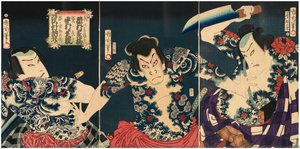
The kabuki actors (right to left) Ichimura Kakitsu IV as Asahina Tobei, Nakamura Shikan IV as Washi no Chokichi and Sawamura Tosshi II as Yume no Ichirobei, IV/1868
[Mitate] Actors in the evening, returning to the dressing room
Genji Viewing Snow From a Balcony
Typical colors:
earthy
neutrals
Copyright status: Public domain
Viac…
Died: 1900
Nationality: Japan
Color intensity: balanced
Lifespan: 65 years
Museums on APS:
Art Gallery of South Australia
Art Museum RIGA BOURSE
Bujalance Collection
Keio University Library
Museums Victoria
Art period: 19th Century
Best occasions: cultural
Movements: ukiyo-e
early life and training
toyohara kunichika, a renowned japanese woodblock print artist, was born on june 30, 1835. recognized for his exceptional talent at a young age, he became a student of utagawa kunisada, tokyo's leading print maker, at the age of thirteen.
artistic style and themes
kunichika's deep understanding of kabuki drama led to his primary production of yakusha-e, woodblock prints of kabuki actors and scenes from popular plays. additionally, he portrayed women deemed beautiful (bijinga), contemporary social life, and a few landscapes and historical scenes.
kunichika successfully worked during the edo period, carrying those traditions into the meiji period. his contemporaries and modern art historians view this as a significant achievement during a transitional period of great social and political change in japan's history.
key contributions:
preservation of traditional japanese print-making techniques.
influence on the development of modern japanese art.
resources
for more information on toyohara kunichika and his works, visit:
shūsei's profile - explore another influential japanese artist from a different period.
conclusion
toyohara kunichika remains an important figure in the history of japanese art, particularly in the realm of woodblock prints. his dedication to preserving traditional techniques while adapting to changing social and political landscapes has left a lasting impact on modern japanese art.
Redakcia AllPaintingsStore.com
Kvíz o umení
Pri každej otázke je iba jedna správna odpoveď.
Otázka 1:
Toyohara Kunichika was primarily known for his woodblock prints depicting:
Otázka 2:
Kunichika's artistic training began at the age of:
Otázka 3:
During which period did Toyohara Kunichika primarily work?
Otázka 4:
What was a significant characteristic of Kunichika's artistic style?
Otázka 5:
Kunichika's early career was heavily influenced by:
Explore the profound beauty of Japanese Ukiyo-e. Discover the history, masters like Hokusai, and the enduring legacy of the 'Floating World' through an expert art-historical lens.
Ponorte sa do sveta Katsushika Hokusaiho a objavte 25 jeho najznámejších umeleckých diel. Ukiyo-e, The Great Wave, Fujiyama – príbehy za ikonickými obrazmi. Kvalitné reprodukcie pre váš domov na AllPaintingsStore.com.
Explore the captivating world of Ukiyo-e – Japan's iconic woodblock prints! Discover masters like Hokusai & Hiroshige, learn about Edo period culture, and find expert art collecting guidance at AllPaintingsStore.


![[mitate] Actors In The Evening, Returning To The Dressing Room — Toyohara Kunichika](/media/artworks/images-thumb/e3/f8/e3f80dd3372e57f69ae58e37c73e0518.jpg)


![Scene From Kabuki Plays : [shinobugaoka Koiwa Kusemono] — Toyohara Kunichika](/media/artworks/images-thumb/e0/e5/e0e59c94a704e46936dcd30033b71dcd.jpg)


